New Perspectives and Reinforcing Experiences

This week’s blog is by Canadian undergraduate student Riley Steidel, who joined SCRAP this year as a field assistant/volunteer. While last week’s blog by Dave talked about “Lasts,” Riley’s blog focuses on “Firsts.”

It was nearly one year ago exactly when I contacted Dr. Meaghan and Dr. Shawn for the first time in the small hope of being able to work on their Alberta-based Old Bezanson Archaeology Project (OBAP; see @obaparky on Facebook/Instagram). It didn’t exactly feel like something that would pan out for me (despite my best attempts at optimism, disappointment is often the rule rather than the exception). Still, I’ve habitually jumped at opportunities, no matter how far-fetched they seem. It turns out that working on OBAP wasn’t as ludicrous as it first appeared. They hired me that summer, and I got to work on an archaeological “dig” for the first time.

Me (yellow vest) and my friend Isabelle excavating along a early 20th-century settler house foundation berm at the Old Bezanson Townsite in Alberta, Canada.

That experience in Bezanson solidified my introduction to archaeology. Before that summer, I was still humming and hawing over what I would inevitably do at university, with my degree, and in the workforce. While it’s impossible to say definitively what will happen in the coming years, I can confidently say that my path seems more straightforward. Now that I am in Belize (another situation where I anticipated disappointment), I am getting an altogether new perspective on things, but one that does nothing to dampen my resolve.

Back in Alberta, I drove to the site around eight every morning. I was staying at home, sleeping in my own bed, and living the same as I had been for most of my life. Working in Belize has been different. Here, I hear other languages (e.g., Mopan, Belizean Kriol, Spanish), taste different foods, see new plants (funnily enough, one of my greatest interests), and live altogether differently. One evening a few days ago paints this picture quite perfectly.
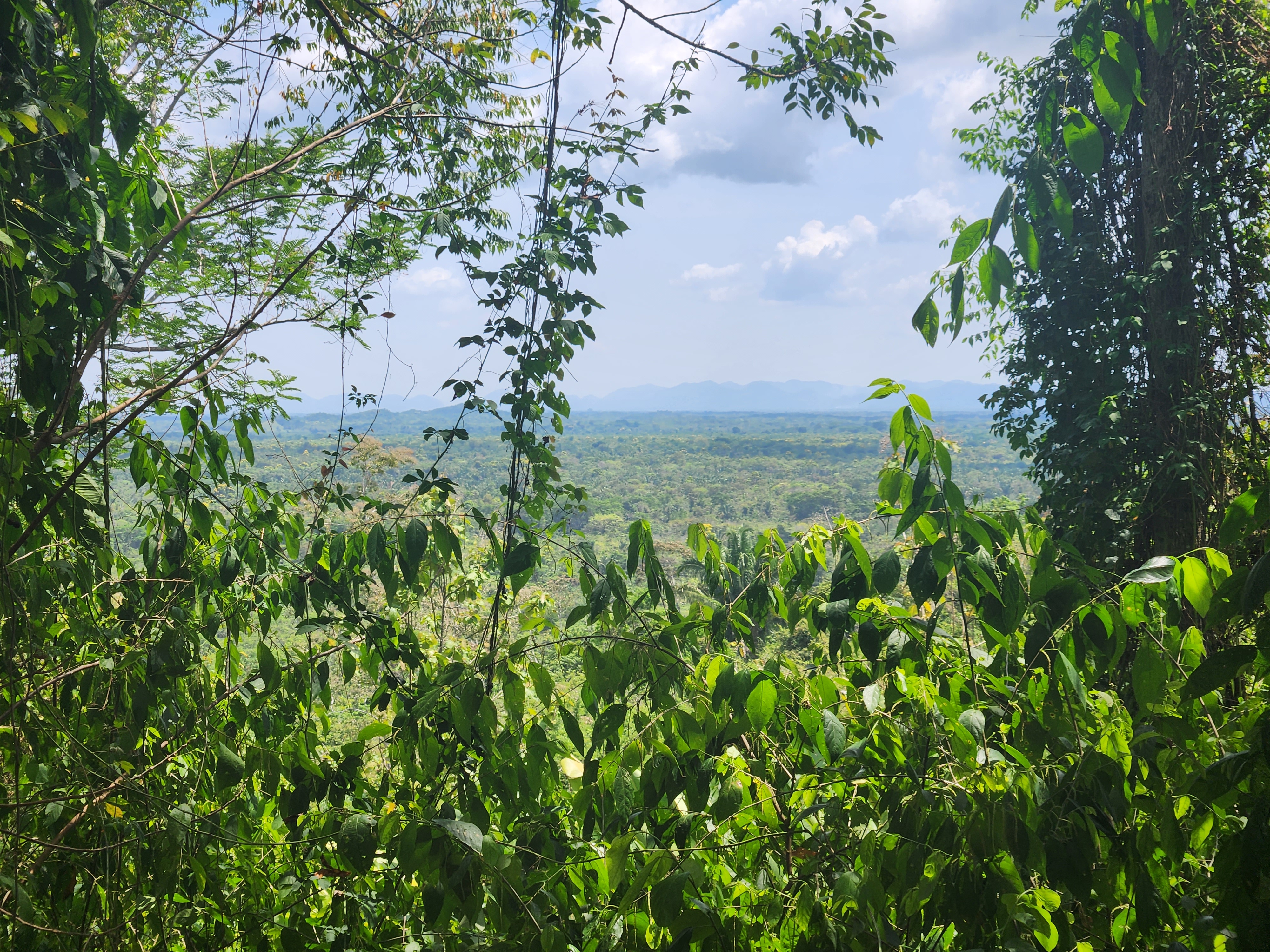
Belizean landscapes are so beautiful, I seem like a decent photographer!

The season’s first rain had just fallen, and we were invited to join Mr. Ernesto and Ms. Aurora’s family for dinner. As always, the food was home-cooked and delicious. The menu on this particular night was a lovely turkey soup with a side of rice and candied pumpkin. To drink was this absolutely delectable rice juice (“Horchata”). After we finished dinner, Mr. Ernesto stood up. He told us we were entering the planting season for corn, an important staple crop in the Maya diet. He explained that traditionally, Maya would do certain things to predict how the crops would fare. One such activity is Bul or Puluk. In this game, two or four players try to get as many points as possible by going from one side of a board to another, moving according to four pieces of corn marked on one side—essentially, two-sided dice. It sounded like a fun game, and I was honoured to participate in it as SCRAP’s representative! It was a fun game, even though I wasn’t particularly good, and I was up until midnight playing with everyone. It was tough waking up the following day to head into the field, but it was well worth it!
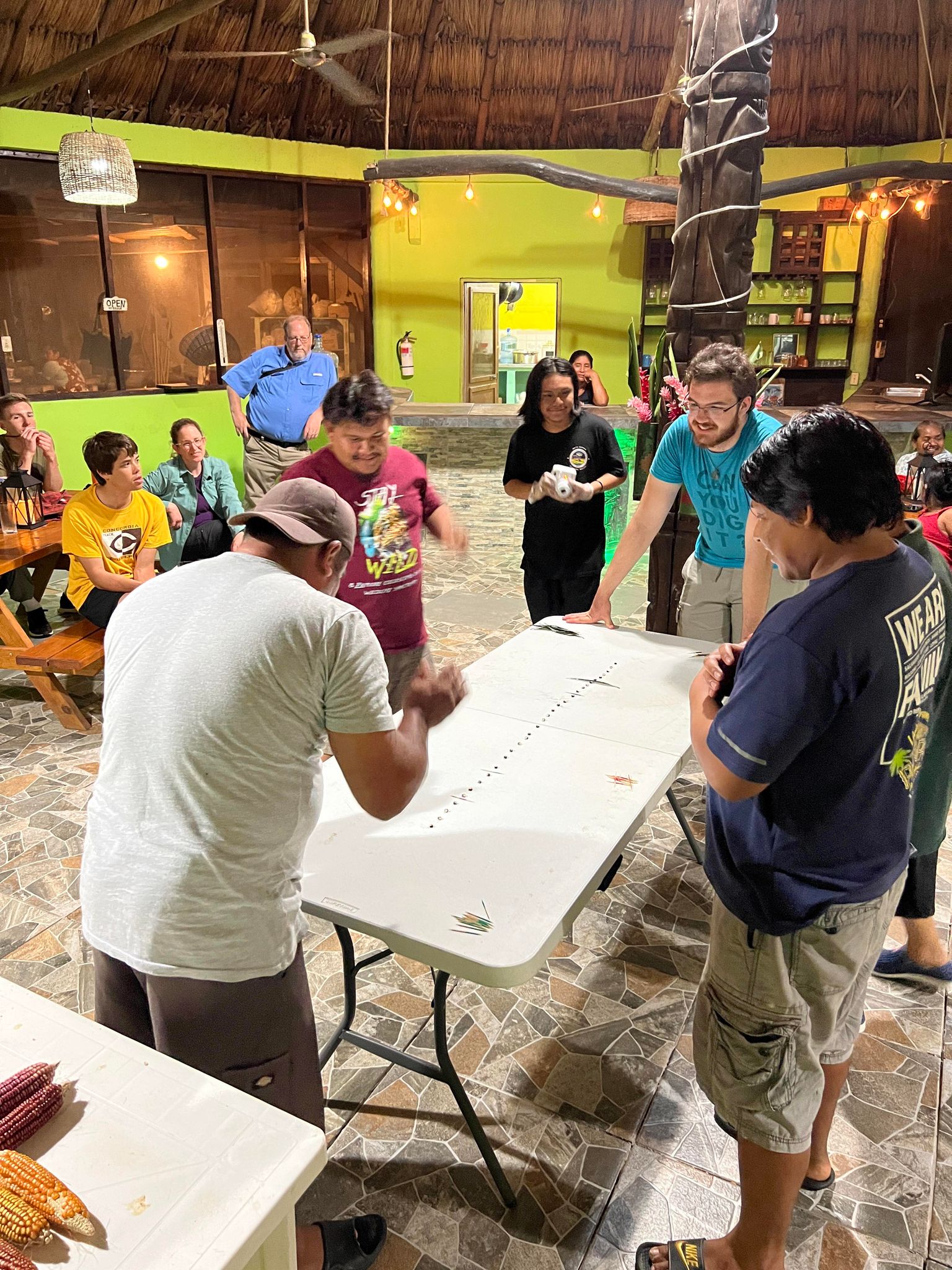
Here I am (in the blue shirt) battling it out with my game partner against our opponents. I ultimately failed.

So what am I getting from all this?

The first thing is a new perspective on how archaeology is done in Belize as compared to my experience in Alberta and seeing another country’s actions toward their Indigenous Peoples. Both are critical topics that have the potential to be very applicable to my future back home. Another important aspect is our personal interactions with the communities within which we operate. It can be seen in how we, as project members, take part in local traditions, be it Bul, a blessing and offering ceremony by Mr. Ernesto and Ms. Aurora, or any of a dozen small customs that are a part of the daily life of the Maya Peoples we work and live with. The honour I feel for being allowed to partake in, and the respect I see in the project for these crucial traditions, give me hope for the future of archaeology because if one project can do it, all of us should be able to.

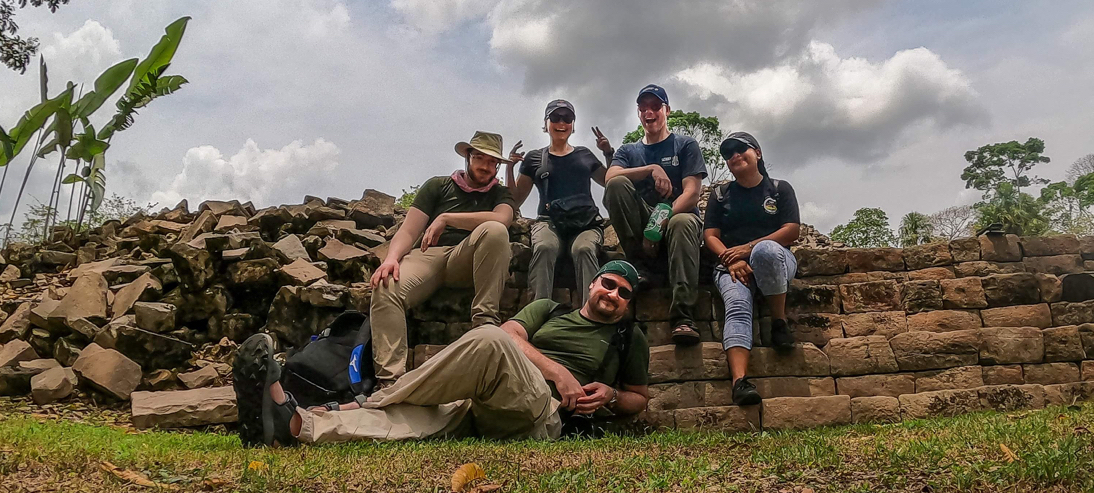
Almost the entire SCRAP crew atop the recently cleared Coconut Mound at the Alabama Townsite, Stann Creek District, Belize: young and old, foreign and local, experienced and inexperienced, women and men. Watch for our formal crew photo next week with our full team!

I wasn’t sure what I would do at school a year ago. Six months ago, I was pretty confident I was on the path that I had chosen. Now, as I sit in the darkness of another Belizean night, I am sure. I know it is a long road ahead, a practically unfathomable distance before me. I don’t know where, when, or with whom I will work. Still, I can confidently say that archaeology will be a part of my future. I hope each new experience—each of my “Firsts”—will show me new perspectives that I can carry forward in school, work, and life.

It Feels Something Like an Ending

This week’s blog post is written by Mr. Dave Blaine who is a student in the Master’s of Interdisciplinary Studies at Athabasca University. Here he reflects on his first week in Belize and the future.

Its about 3pm on Saturday afternoon, and I’ve been travelling by bus, taxi, and commercial jetliner for most of the last two days. I’m squeezed into a tiny, noisy airplane with 8 other passengers, all of them clad in the garb of sun-seeking vacationers.

The pilot races onto a taxiway, corners hard and peels onto the runway – taking off quickly and unceremoniously – as though the departures gate at Belize City’s Philip S. W. Goldson International Airport was for him, just another bus stop.

Out my left-side window, a strut supporting the wing reads #FlyMayaBelize.  Beyond that, a seemingly endless expanse of turquoise Caribbean. I raise my camera to my eye and immediately start shooting. It isn’t lost on me that this may well be my last visit to Belize for the foreseeable future. SCRAP’s current funding cycle ends this season, and I will launch the final project of my master’s in September. There’s an unmistakable air of completion and ending to this season, and regrettably, rather than sitting back and enjoying the voyage, my head is reeling with images, shot lists, and to-dos.

Short Flight to Dangriga

This is my last chance to make good… and I’ll be damned if I’ve figured out yet just how to tell this story.

SCRAP has become a blur to me. A jumble of interrelated scenes, and diary entries that only the benefit of hindsight will eventually help coalesce into something vaguely story-like, and hopefully with an insight or two to share. The last week has been filled with these little vignettes:

Touring Ms. Aurora and Mr. Ernesto’s farm, chewing on stalks of fresh-cut sugarcane, while their farmhand, Don Antonio – who looks for all the world like The Old Man of the Sea – spreads spoonfuls of a pasty green mixture around the bases of several plants, to save them from the leaf-cutter ants.

Mr Ernesto and Ms Aurora at their farm

Digging out last year’s excavation, the rock-hard backfill dirt eventually peeled off the plastic sheeting we had laid down to preserve the unit floor and walls in the same way accumulated ice might chip off a frozen sidewalk. Sharing that comparison with my Belizean companions, to which a philosophical Mr. Paquiul observes very simply, “Different places.”

Digging out 2022 backdirt at ALA-003C

Sitting in the passenger van, while Meaghan and Shawn buy a round of ice-cold drinks after an especially hot day, Mr. Justino, many years my senior, laughs out loud when I suggest I might be getting too old for this. With a tinge of regret, he tells me that he thinks this may be his last season in the field.

Mr Justino preparing to build a shelter

This strikes me. He joined SCRAP in the field in 2018, the same year I did. That’s when I knew… this isn’t an ending. SCRAP will carry on, with new partnerships, funding opportunities, research questions, and initiatives, to become the regionally focussed project that it was meant to be, and that it deserves to be. Our companions will carry on, building their communities, and advocating for their culture. And I’ll carry on as well, taking this multimedia storytelling thing I’m concocting to the other archeology projects of the world, like I should.

No not an ending, but probably a Last.

Lasts are tricky. As people, we don’t usually see them coming with the same clarity as we see Firsts.

As I reflect on the people I’ve met, worked, and lived with over 4 all-too-short seasons of fieldwork; people whose knowledge, experience, and generosity I’ve been privileged to share; I can’t imagine any other circumstances in which I would have become so close, so quickly, to so many different people, and it’s hard to come to terms with the fact that this may be the last time I will see many of them, and I will miss them.

All Of This Has Happened Before And Will Happen Again

If, like Meaghan and Shawn, you are “of a certain age,” you’ll recognize the title of this blog as an oft-repeated quote from Battlestar Galactica. The show and its subtext, while arguably kicking off this Golden Age of television that we are currently enjoying (btw, what are you doing reading this? Have you seen The Last of Us yet?!), have absolutely nothing to do with the topic of this week’s blog. The quote itself, however, captures the feeling with which we start this, our seventh field season of the Stann Creek Regional Archaeology Project (SCRAP).

This has happened before. We are returning to the Alabama Townsite and the Stann Creek District, continuing our research program into the timing and tempo, the flavour, and the identities and motivations of those driving the development of this Ancestral Maya townsite in the latter half of the Late Classic period.

Last Sunday (with only a few minor bumps along the way… picture the airport scene from Home Alone), co-directors Meaghan and Shawn arrived safe and sound in Belize. We spent three days staying with our good friends in Cayo (thanks, Ms. Erva and Mr. Landy), made trips to Spanish Lookout to purchase equipment, and reconciled ourselves to the relative heat of Belize.

On Wednesday, we picked up our second rental vehicle (thank you, Mr. Eldridge at Flames Auto) and headed to Belmopan. We had an enjoyable lunch with Maya Prince: an activist, journalist, and host of the Maya Culture-Belize Facebook Page, who is making an impact across Belize and beyond. We also met with Dr. Badillo at the Institute of Archaeology. We caught up on some exciting initiatives they are driving and picked up our research permit (Brett Houk, we are No. 11… which is like “1” but twice).

Our lab buddies.

We then went south, receiving a warm welcome from our hosts, friends, and SCRAP collaborators in at Nuuk Che’il Cottages in Maya Centre (Ms. Aurora, Mr. Ernesto, Rigo, Gabriel, and Marroquin Saqui). On Thursday, we braved the scariest task in any archaeological project: opening up our storage. We pulled out, dusted, sorted our gear, set up our lab and room, and added to the list of things to buy! We set up our various communications systems on Friday and did some “work” work.

Saturday, we drove out to Maya Mopan to meet with community leaders (including the village Chairman, Alvino Teul) and various project members and supporters (old and new) before picking up Dave and Riley at the Dangriga airport, getting them settled, then having a lovely dinner at Driftwood in Hopkins.

Finally, on Sunday, we loaded the van with Dave, Riley, and Ms. Sonieda Teul (our new Educational Outreach Advisor) and visited both Lubaantun and Nim Li Punit in the Toledo District. We also made sure to stop by Che’il Mayan Products for some delicious, cold chocolate milk!

This should all sound familiar if you follow us on Instagram or Facebook (@scraparky). As previously written on this blog, this first week is about preparation for the coming season. By this point, the process is pretty smooth (we even had time to enjoy ourselves!).

And it will happen again. This year, however, our preparations are bitter-sweet. This season is the last covered by our current SSHRC Insight grant, which means it represents a transition. As usual, we’ll keep you apprised of our activities as the season progresses, with our weekly blog posts written by different project members and in a different voice each week, along with some special “extra” posts. We’ll also spend some time looking back. How has our understanding of Alabama developed over the past seven years? Which of our ideas has found support? Which haven’t? How have our methods changed, and what have we learned? And we’ll look to the future. How do we pivot to the following research stage at Alabama and Stann Creek District? What else do we and our local colleagues want to know? How do we build on what we’ve learned? How can we develop along with our communities, and how will this require us to change?

We look forward to exploring these ideas, and we would be grateful for your input. (Leave us a comment!)

So say we all.