The SCRAP team will be presenting results of their 2015 season at this year’s BAAS. If you are in San Ignacio, Belize from 27 June to 1 July 2016, you should come check out this wonderful conference.


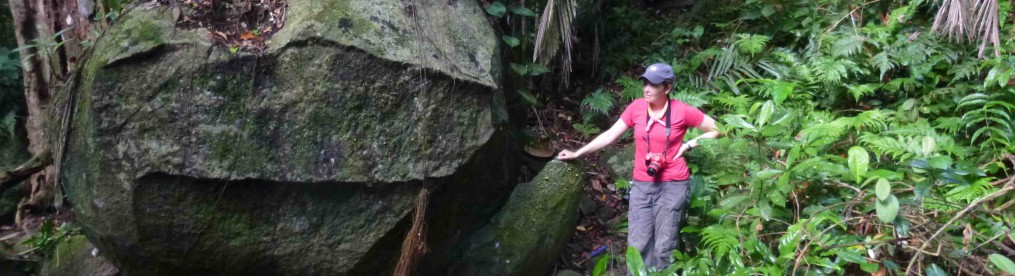
The SCRAP team will be presenting results of their 2015 season at this year’s BAAS. If you are in San Ignacio, Belize from 27 June to 1 July 2016, you should come check out this wonderful conference.
I am happy to finally be able to officially announce that the SCRAP team was awarded a Social Sciences and Humanities Research Council of Canada – Insight Development Grant for 2 years (July 2015 to June 2017) of preliminary research at Alabama. We’re 6 months in and our 3 P’s (practice-participation-promotion) are so far a great success. Looking forward to 2016!
You can see our research listed by clicking on the following link, and scrolling down to “Alberta” and “Athabasca University”.
http://www.sshrc-crsh.gc.ca/results-resultats/recipients-recipiendaires/2015/idg-sds-eng.aspx
Happy Holidays and New Year from the SCRAP team!
Cheers,
Meaghan

Last week, Dr. Peuramaki-Brown and I (Megan Williams) traveled from Calgary, Alberta to Hamilton, Ontario where we worked in the McMaster Archaeological XRF Lab (MAX Lab; http://maxlab.mcmaster.ca/ ). We brought with us the obsidian collected during the SCRAP 2014-2015 surface surveys at Alabama, in order to determine the source of each piece (i.e. the various volcanic regions/flows of Guatemala, Mexico, or “other”). This analysis will help us to place Alabama within the trading spheres of the ancient Maya world, which we hope will help in our on-going investigation of the site as a possible example of a rapid settlement related to resource development and management. Additionally, we hope this research will also contribute to larger discussions focused on questions of Maya social, political, and economic organization(s) during the Classic to Early Post-Classic periods.
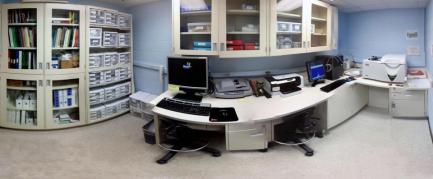
The MAX Lab at McMaster University (Photo from http://maxlab.mcmaster.ca/)
We are collaborating with Dr. Tristan Carter who graciously granted us permission to use the desktop Energy Dispersive X-Ray Fluorescence (EDXRF), in order to determine the elemental composition of each of the Alabama obsidian artifacts. These compositions are then compared to various source samples. For a concise, ‘not-too-sciency’ explanation of the technique, visit the following website and download the free document XRF Technology for Non-Scientists (http://info3.thermoscientific.com/XRFeBookDownload). The weekend was a fantastic opportunity for learning the procedures necessary to conduct EDXRF analysis on obsidian artifact and source materials; how to correctly interpret the data; and issues facing analyses using complex and expensive technology.
For the remainder of this post, I will briefly outline the analysis process for you. The artifacts were unpacked from their marked bags and cleaned using an ultrasonic cleaner. This step ensures that artifacts are free of any dirt or debris that might inhibit the x-ray beam from reaching the obsidian surface. This is an important example of considering the order of analyses, as any residue analysis must be done prior to this stage. Given that all of these pieces were surface collected, we decided not to pursue any residue analysis at this time.
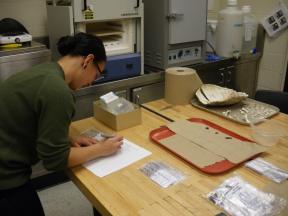
Artifacts being unpacked by Megan (Photo by M. Peuramaki-Brown)
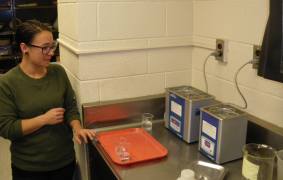
Megan cleaning artifacts in sonic cleaners (Photo by M. Peuramaki-Brown)
After being cleaned and rinsed with distilled water, we cautiously affixed the flattest surfaces of the obsidian pieces to the part of the sample tray that would be hit by the beam. Each tray is circular and had enough space for us to affix nineteen samples, plus the standard sample that would ensure the accuracy of our results. We filled up almost three trays with obsidian and ran them individually.
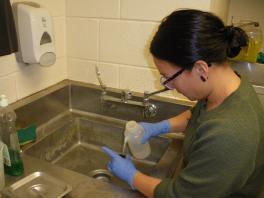
Megan rinsing the cleaned artifacts with distilled water (Photo by M. Peuramaki-Brown)
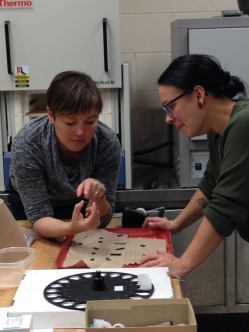
Dr. Peuramaki-Brown and Megan examining the individual artifacts to locate flat surfaces prior to affixing pieces to the trays for analysis (Photo by C. Cluney)
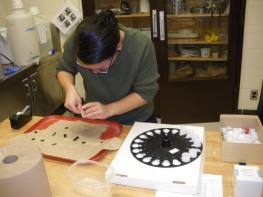
Megan positioning the obsidian artifacts on the analysis tray (Photo by M. Peuramaki-Brown)
Each tray takes roughly three hours to analyze, so in our down time we were able to sit in on one of the McMaster Anthropology graduate student’s thesis defense (FYI: she nailed it). When analysis of the tray is complete, the data is printed and transferred into Excel, then element ratios are compared to those of obsidian source sample ratios in order to attribute source location.
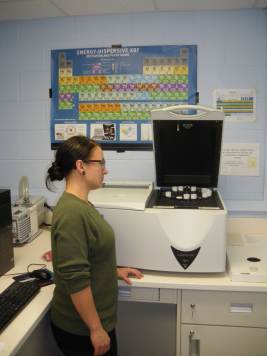
Megan loading tray into the desktop EDXRF (Photo by T. Carter)
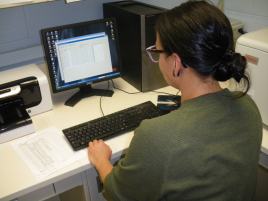
Entering artifact tray data into the computer prior to analysis (Photo by T. Carter)
Dr. Peuramaki-Brown and I thought we had a pretty good idea of where the majority of artifact materials had originated from, based on considerations of currently understood site occupation dates and location; however, our data has produced some extremely interesting and unexpected preliminary results. Watch for my undergraduate independent study and co-authored presentations/publications in the new year! These results will be further investigated in upcoming field seasons and laboratory analyses.
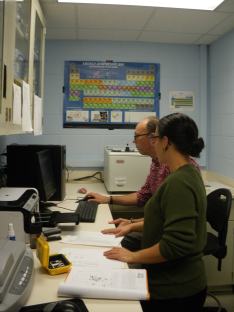
Dr. Carter and Megan going over the surprising results of the XRF characterization
A big thank you to Dr. Carter and the staff of the MAX Lab at McMaster University for hosting us and letting us use their facilities.
Cheers,
Megan Williams
(Senior Undergraduate Student, Anthropology Program, Athabasca University)
Last week, I drove 5 hours north of Calgary, Alberta, to visit the main campus of Athabasca University in Athabasca, Alberta. I was there for 2 purposes: (1) to visit the campus for the first time, and (2) more importantly, to test out AUs new 3D scanner and printer.
While in Athabasca, I met up with Colin Elliot in our Library Services department. Colin taught me how to use the NextEngine 3D Laser Scanner to scan a few different types of artifacts; for example, we scanned one of the body sherds from Alabama that we will be subjecting to petrographic analysis later this year. We are currently in the process of scanning some of our obsidian pieces, which require a dusting of special, removable powder in order for the scanner to properly detect the glassy surface (obviously something you would want to consider only after any residue testing you might be considering). We also printed off some of the scanned items using the 3D printer.
This was a test run prior to purchasing a scanner to be used by SCRAP in Belize next season. There we will be able to produce scans of items that we do not wish to / need to / cannot export. These scans will be used for the purpose of research, public outreach, as well as teaching tools in the AU Virtual Archaeology Lab. I will post some of the scans as soon as we are done converting them into manipulable PDFs. Cheers! Meaghan
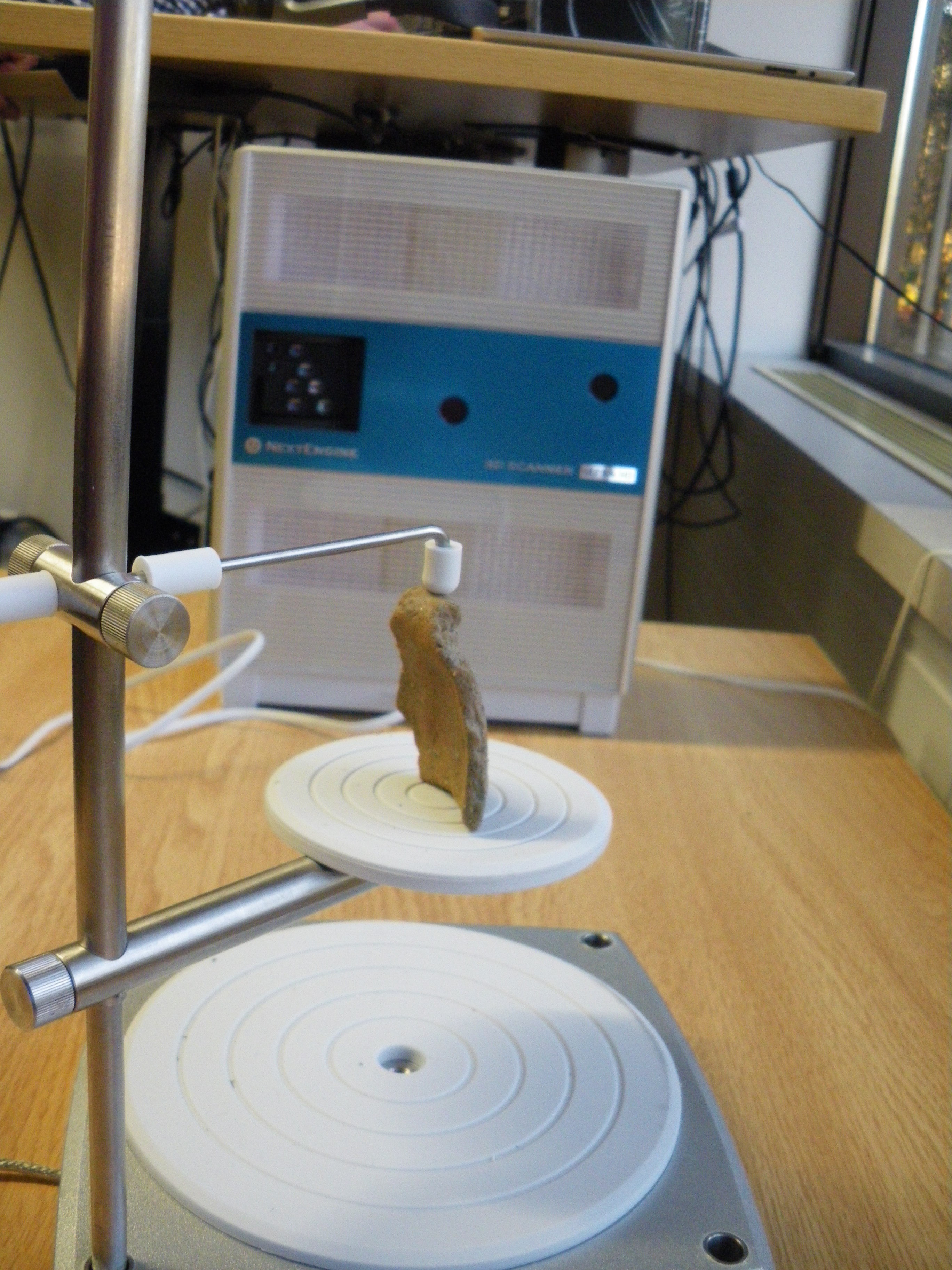
Scanning the sherd

Cropping the images

Matching up the individual scans
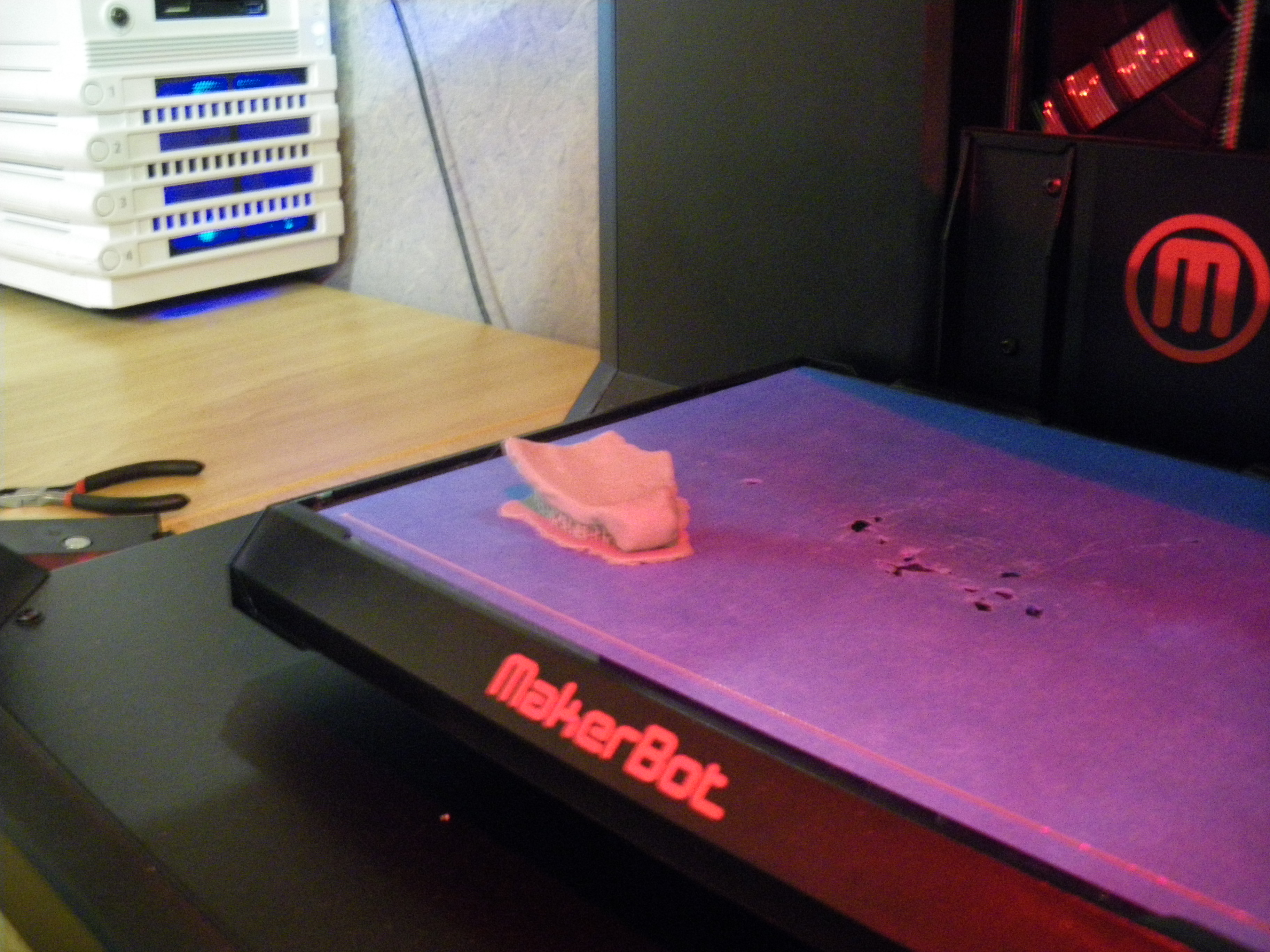
Printing the object

The printed product
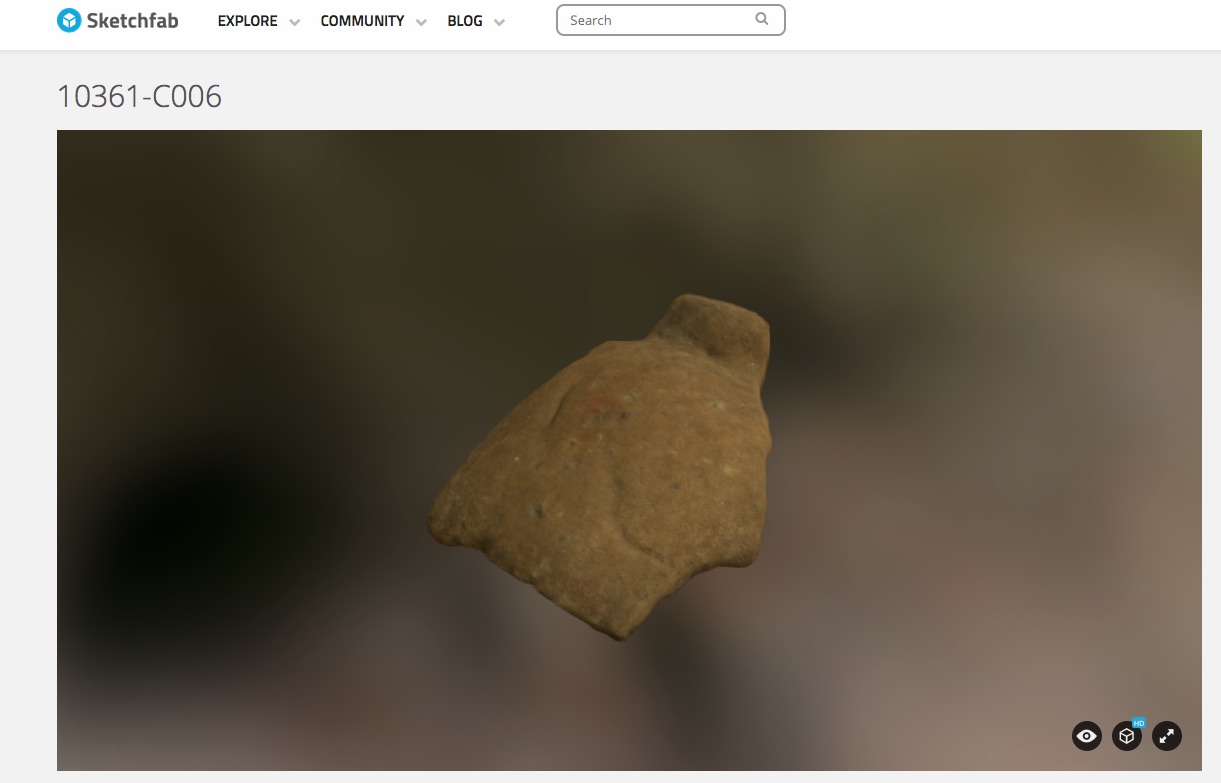
3D model on Sketchfab
Hi Everyone. Just an update on what is happening this fall/winter with SCRAP.
Tawny and I are busy trying to pull together an article about our pXRF granite sourcing this season, as well as initial descriptions of the possible granite extraction sites located during the 2014 and 2015 seasons. We are hoping to submit this to Latin American Antiquity. We’ll keep you posted!
Next week I am heading to Athabasca University (the main campus in Athabasca, Alberta) to learn how to use our new 3D scanner and printer. I’ll be scanning (with the help of our wonderful library-IT staff) some of the artifacts I exported this season. (Watch for upcoming blog post and photos.) These scans will form part of what will be the Athabasca University Virtual Archaeology Lab — a teaching, research, and outreach tool — that we hope to have up and running some time in 2016-2017.
In November, I am heading to Hamilton, Ontario, along with an Athabasca University undergraduate student (profile to be posted ASAP under “Project Members” tab), to conduct X-Ray Fluorescence analysis on the obsidian we collected this season. This will be done in conjunction with colleagues at the Max Lab at McMaster University (http://maxlab.mcmaster.ca/). This will allow us to source the materials and begin discussing Alabama’s role in Late Classic period trade routes. This will be part of the undergraduate student’s independent research study. (Watch for blog post and photos.)
Additionally, we will be conducting petrographic analysis on our ceramic source test briquettes and surface collection sherds, to begin discussing sourcing of clay and temper materials in the Alabama area. This will be done in conjunction with colleagues at HD Analytical Solutions (http://www.hdanalyticalsolutions.com/) in London, Ontario and at the University of Calgary.
Finally, very soon, we will be pulling together our final report for the 2015 season, as well as our proposal for the 2016 season. Next summer we are hoping to conduct 2 months of excavations at housemounds in the Alabama settlement zone.
More soon!
Meaghan
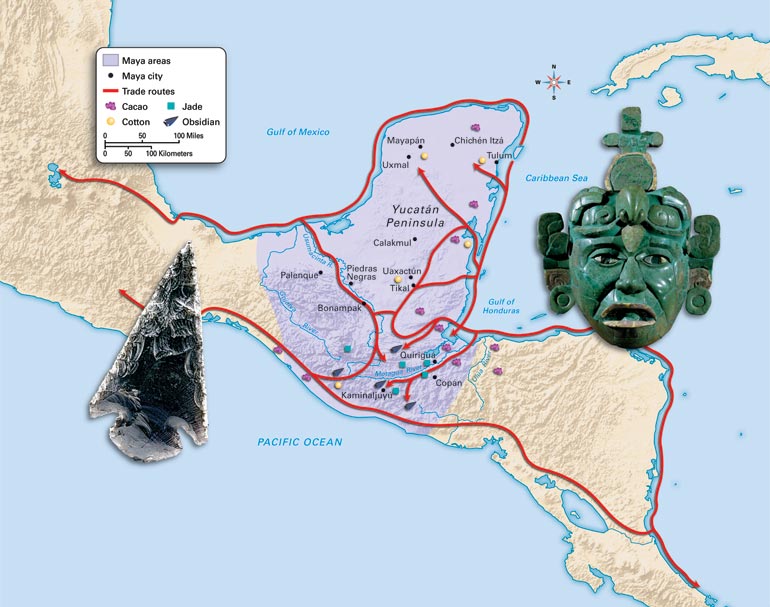
Various trade routes that were in operation in the Classic Maya World (https://mrgrayhistory.wikispaces.com/UNIT+8+-+EARLY+AMERICAS)
Well, we made it. Week 5 was all about lab work.
This week was spent finishing up artifact cleaning; sorting, counting, and cataloguing artifacts; analyzing, photographing, and drawing special finds; doing up an inventory of our equipment; and writing our preliminary report to submit to the Belize Institute of Archaeology (final report to be submitted in the new year). Shawn, Brittany, and I worked hard to get everything done by Thursday (Tawny, Lisa, and Jesucita had to get back home early), and then spent Friday bringing artifacts and equipment to our storage area.
We celebrated the end of our season with Piña Coladas at Sleeping Giant Lodge in the Sibun, and then a lobster lunch in Hopkins!

A dark photo, but trust us that those piña coladas looked and tasted delicious!

Amazing lobster tail on the beach in Hopkins
So, that is it for this season. The fall will be spent conducting further analyses, presenting about our work at a couple conferences, and hopefully getting a preliminary article out on the site. We will also be pulling together our final report of the season, which will be posted along with the 2014 report under the “Publications” tab.
We will continue to post updates throughout the year as we keep ourselves busy thinking about this season and planning for 2016 when we will start excavating many of the settlement mounds we encountered in 2014 and 2015 survey.
A final “cheers” from Belize!
Meaghan
This week marked the conclusion of our various field operations; the last orange row was walked, the last precious artifact surface collected, and the last structure mapped.

SCRAP 2015 Field Crew: (L-R) Brittany Johnson, Dr. Shawn Morton, Jesucita Guerra, Mr. J. Paquiul, Mr. G. Choc, Mr. J. Cal, Mr. I. Cal, Lisa Green, Dr. Meaghan Peuramaki-Brown, Tawny Tibbits
Beyond day-to-day field operations, over the last week we’ve learned new words in Mopan (if not proper spellings)—botik (thank you), kay (ok/yes/good), kosh (let’s go), kosh ti maia (let’s go to work), kosh ti si (let’s get firewood), kosh xi xna (let’s go home). We’ve tried new foods—santa maria (tastes like liquorice and makes your mouth go numb), wild bananas (little fruit…HUGE seeds), heart of palm, water vines. We even made some new toys…
How to make a natural rubber ball:
Step 1 – Find a rubber tree.
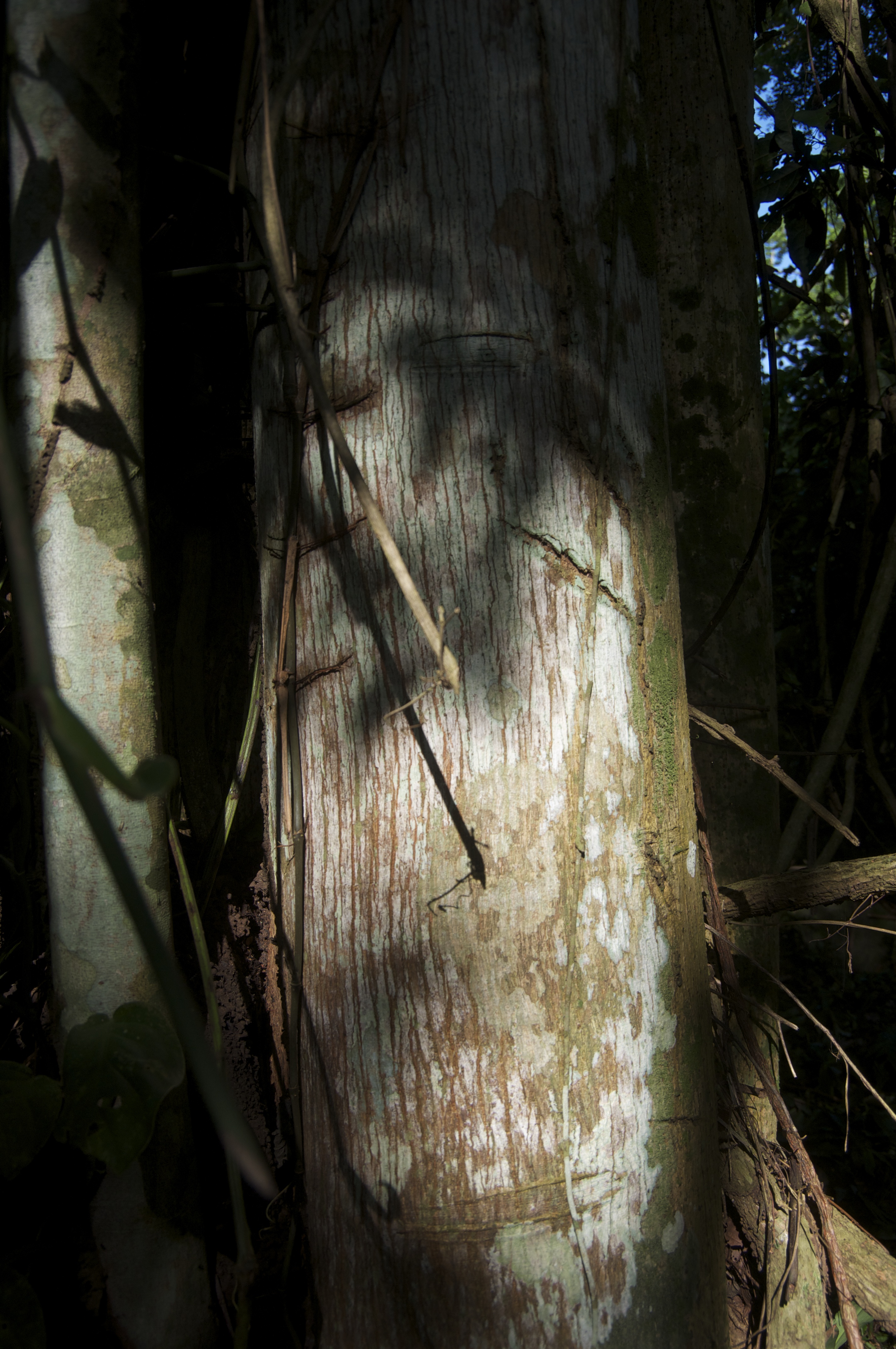
Step 2 – Slash the bark (don’t worry, it heals quickly).
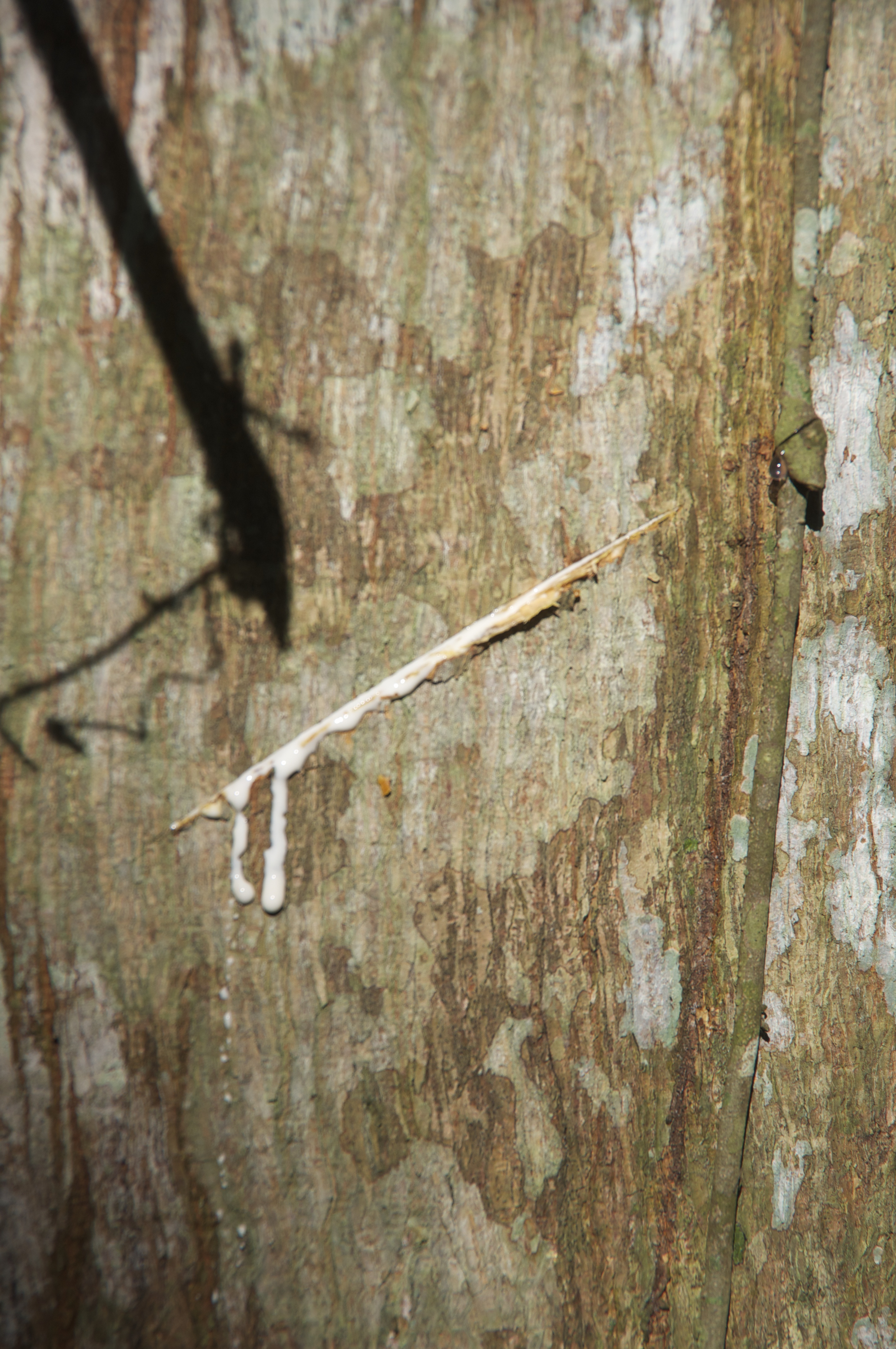
Step 3 – Wait two or three days for the sap to harden (it coagulates and begins to turn brown/black).
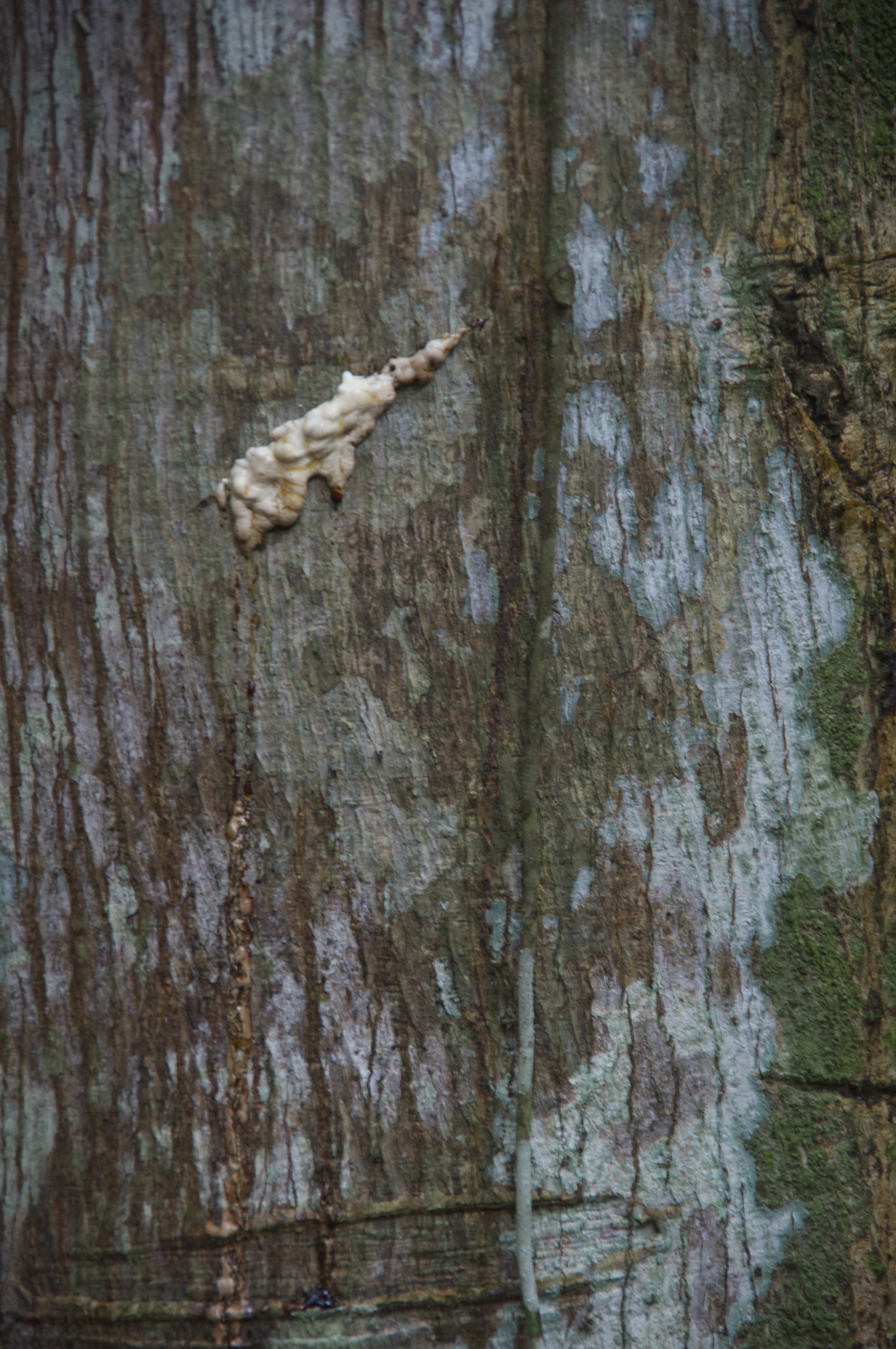
Step 4 – Peel off the stretchy and slightly sticky strips and wrap, and wrap, and wrap.
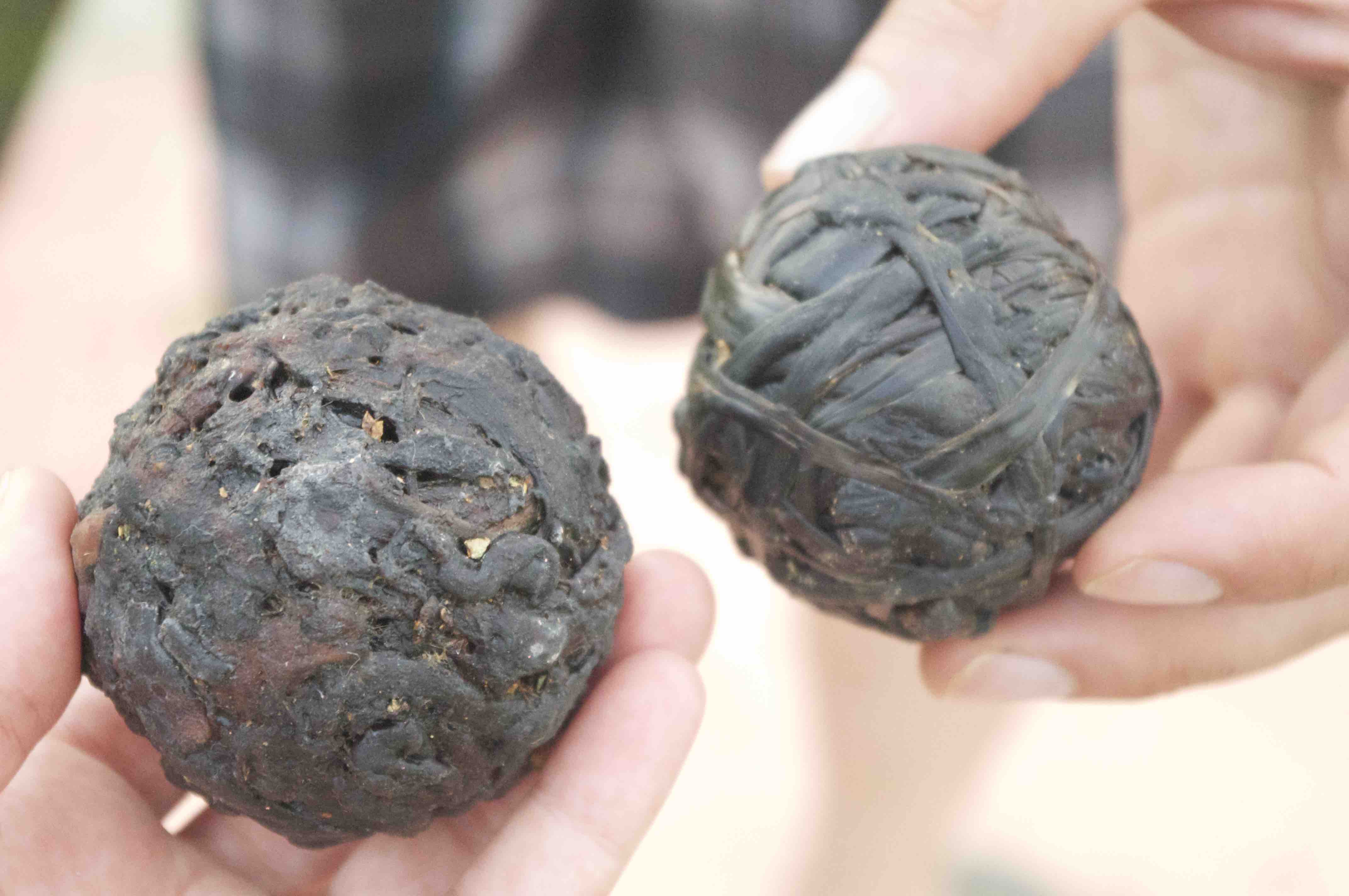 We finished the week with a show-and-tell in Maya Mopan over breakfast, and had some friends come by to register the amazing artifacts they found in the creek while washing.
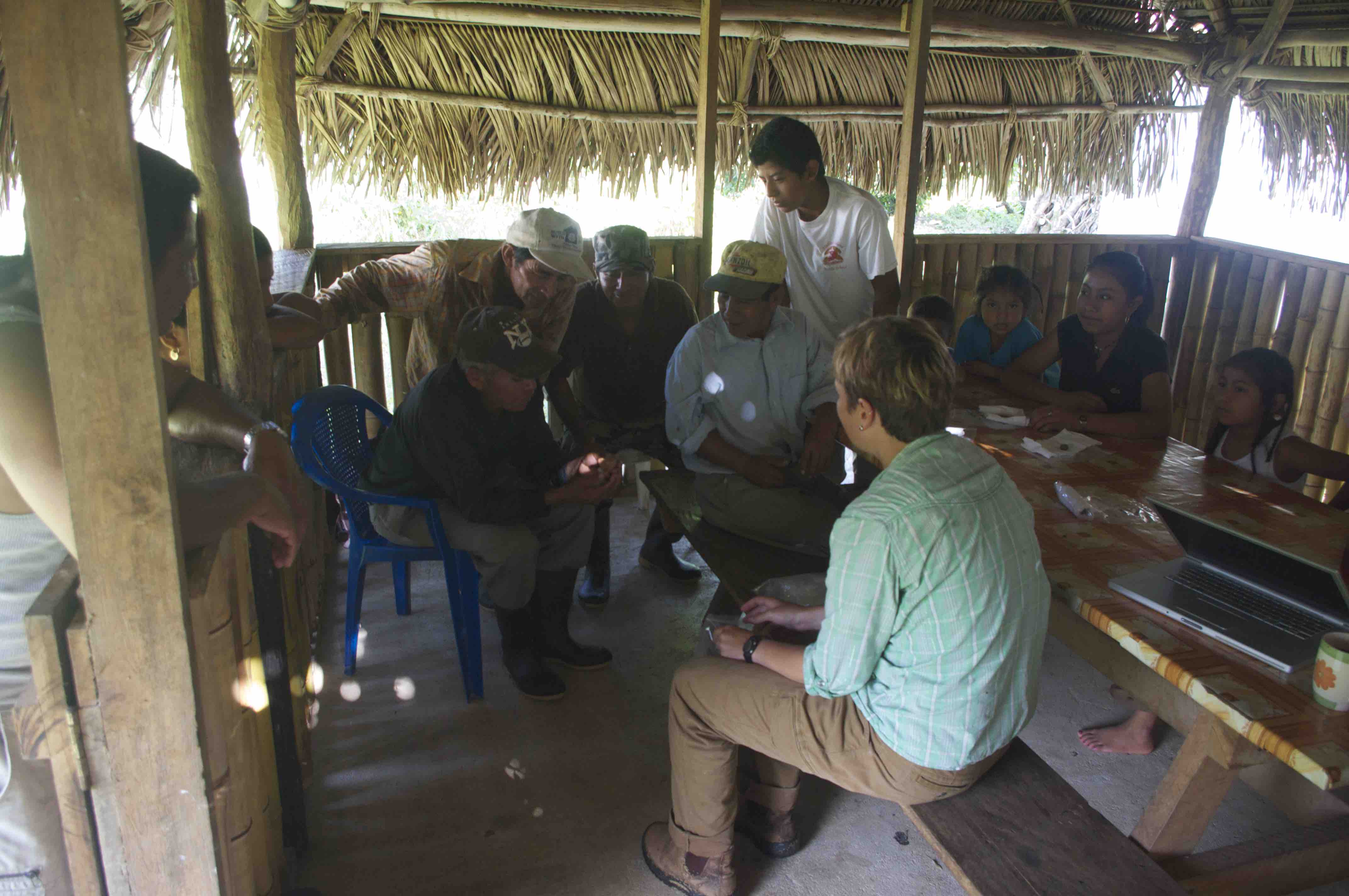
Meaghan showing and talking about the artifacts found during surface collection in the settlement

Shawn showing and talking about the topographic map of the epicentre he has been generating with help from Mr.s Choc, Paquiul, Cal, and Cal
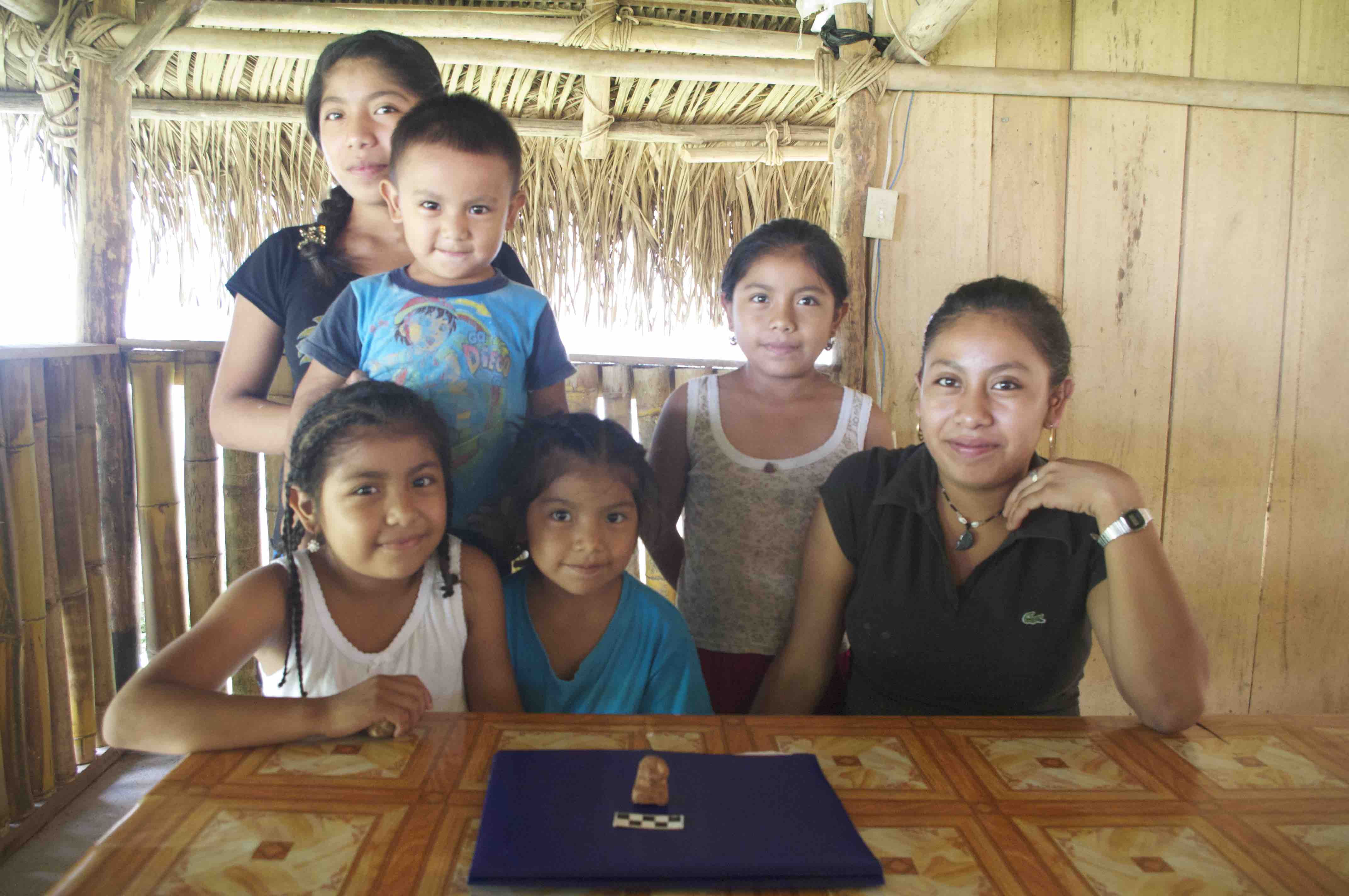
Some excited Maya Mopan residents registering one of their surface finds from the nearby creek
Our focus for our final week lies with the equally important process of photographing, drawing, measuring, describing, identifying, counting, and prepping artifacts for further analysis, export, and local storage.
Until next time!
SCRAP 2015
As part of SCRAP 2015, we have been using a newer technology called portable X-ray fluorescence (pXRF) in order to characterize the geochemistry of local granite outcrops and granite architecture and tools (manos and metates) without having to destroy the artifacts themselves. This is the main focus of project member Tawny Tibbits’ dissertation research. So far no other research has taken place on such coarse-grained rocks using pXRF and Tawny is particularly interested in determining if the machine can produce data that is as accurate as the destructive methods that are more commonly used.
The Maya Mountains provide a nice case study on granite. There are three petrographically (but not necessarily visually) distinct plutons: Mountain Pine Ridge, Hummingbird Ridge, and Cockscomb Basin. During the past few years, and this year with SCRAP, Tawny has sampled outcrops from throughout these plutons in order to develop a database that archaeological materials could be compared to in order to determine the point of origin for the actual raw material. Each of these plutons has variations within them, and she has attempted to collect samples from throughout each pluton in order to capture this variability. Using specific ratios, she can then plot the variability within and between plutons.
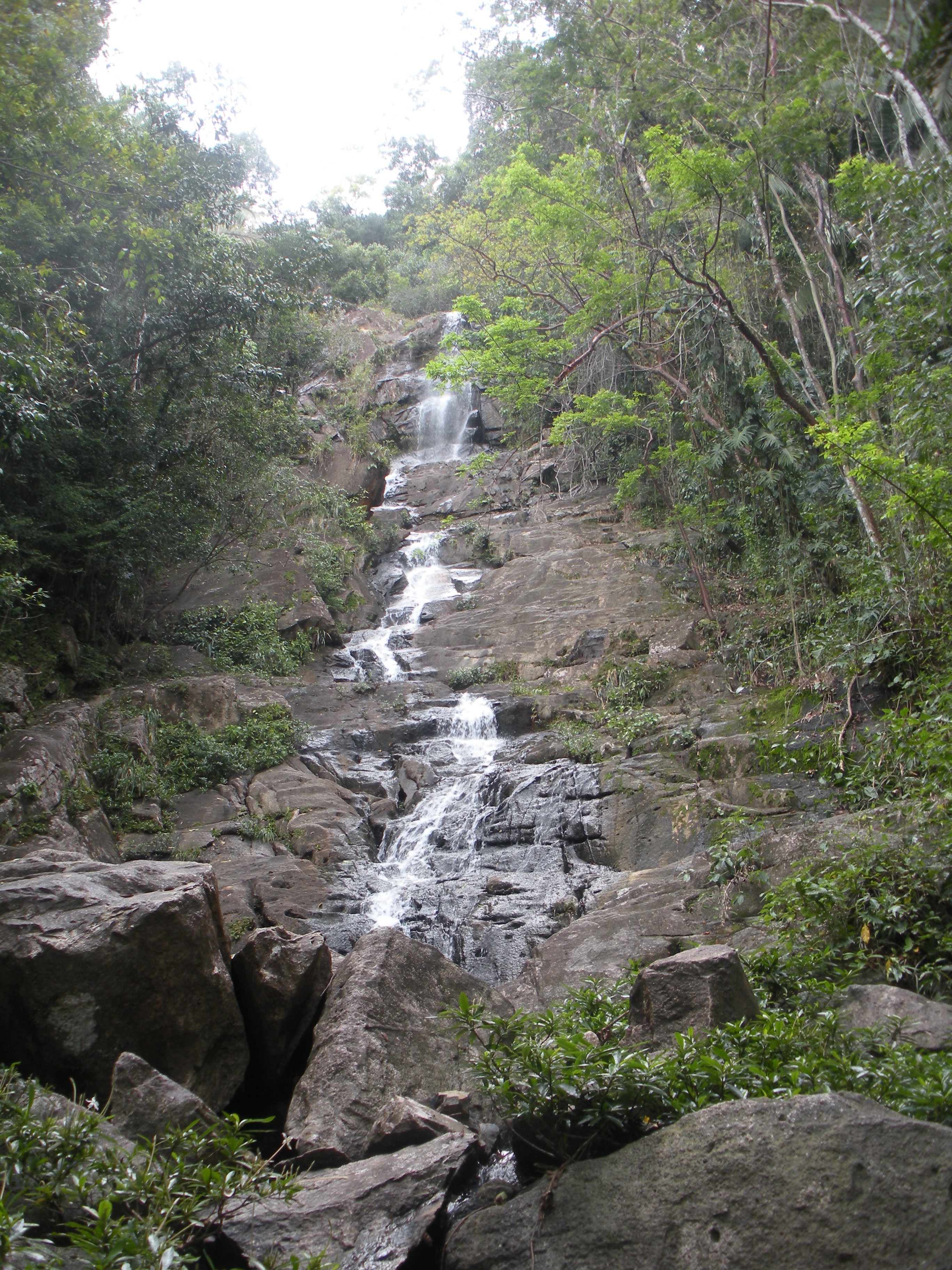
Local outcrop area
Tawny has visited several archaeological projects in Belize to analyze their ground stone tools. Generally the only granite tools present are manos and metates. From this work she is able to determine which pluton the artifact likely originated from. She takes no fewer than five data points per sample in order to get an average geochemical composition. It is necessary to take multiple points since granite has such large crystals. The diameter of the beam on the pXRF is so small that it is possible to only shoot a single mineral at a time, which would not give the overall composition of the rock and would lead to a misinterpretation of the data. So she makes sure to take plenty of data points to get the best bulk geochemical signature possible. She has compared it to the results of powdering the outcrop rocks and has found that about 5-6 data points can approximate the powdered results with the added benefit of not destroying the tool. With this information we hope to be able better understand the movement of ground stone tools to different sites throughout Belize at varying times in the archaeological record. This could shed light on some potential exchange networks as well as their shifts as different sites come into and decline from power.
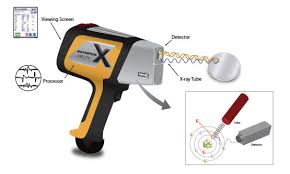
The SCRAP “Granite Gun”! (on loan from U of Iowa)
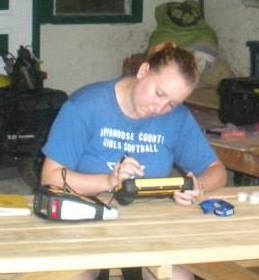
Tawny at work
At SCRAP we have been focusing on locating outcrop areas around Alabama in order to further characterize this area of the Cockscomb pluton, and analyze whatever granite tools and architecture we find during survey and surface collections. Tawny will be crunching all the numbers and coming up with some conclusions when she makes it home next week!

Brittany, Mr. Gonzalo, and Mr. Juan on the search for outcrops!
Cheers from Belize!
SCRAP 2015
We started week three with excellent weather and that was basically a sign that the week would be great. Much was needed to be completed, since last week it was all rainy days making it difficult to get survey done (see previous blog).

Third Week: excellent weather.
The good news for this week is that Shawn and Tawny saved the lives of two cute puppies that were in the middle of the road in Georgetown. These guys deserved to be applauded since they started their week doing good deeds. The bad news was that this week one of our local crew members was not able to make it so we quickly decided that every day one of the women working in the surveying team would go with Shawn to help him with the mapping. It wasn’t the first time mapping for some of the ladies but for those that had a first time mapping it was a great experience.

Shawn and Tawny moving the puppies from the road.
Lisa helping Shawn with the mapping of the epicenter.
On Tuesday a survey team member once again join Shawn in the Epicenter for mapping. The rest of the crew went ahead to finish survey in some of the final property blocks. In the afternoon Mr. Teul took us on a thirty minute hike into the surrounding mountainside to see an amazing waterfall and local granite bedrock. It was somewhat of a steep hike, but it was worth it! The water was so beautiful and the rocks were incredibly huge. It was a great midday trip after all with the SCRAP Crew and Mr. Teul.
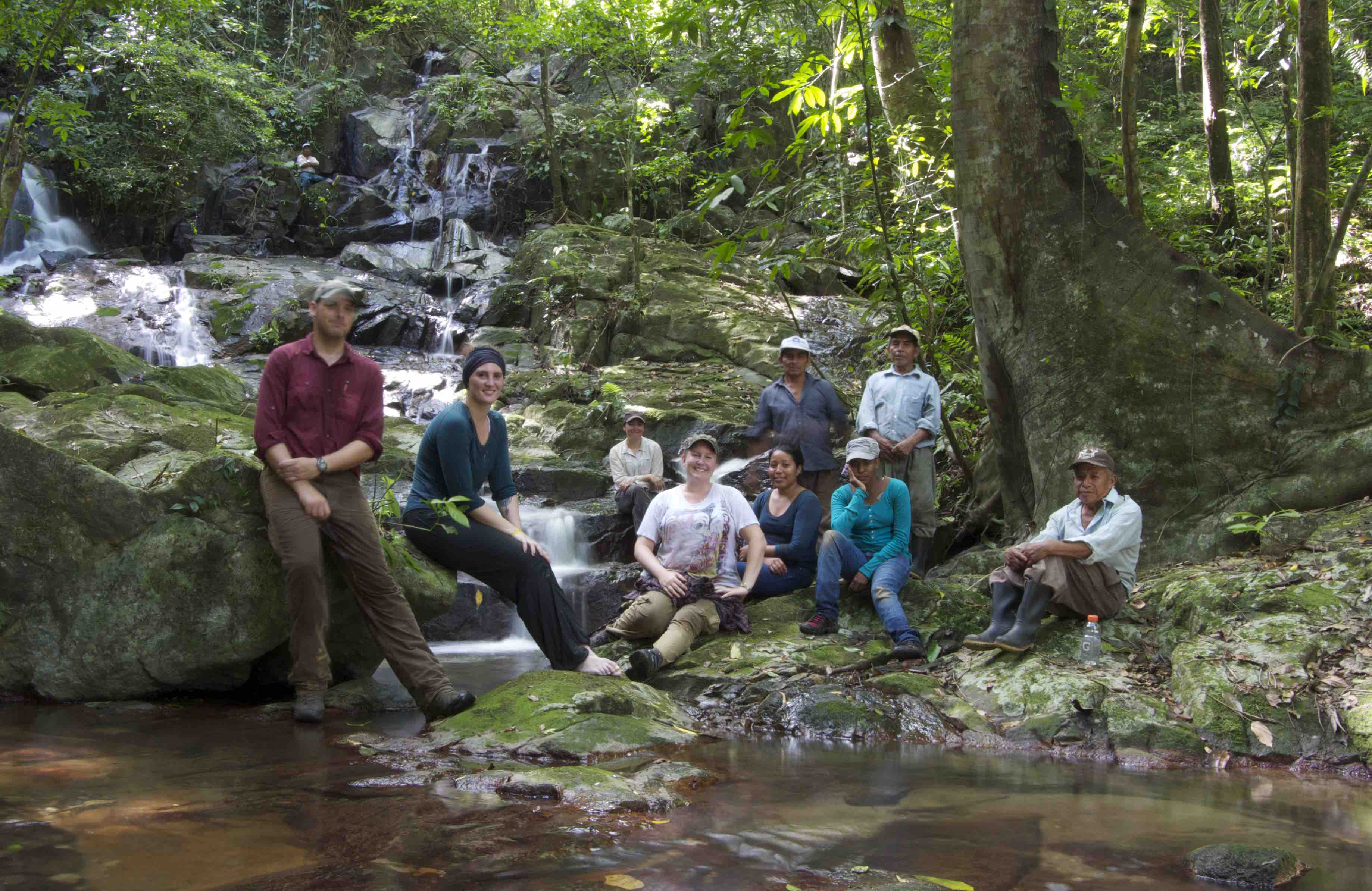
Our short trip up the mountain with Mr. Teul.
Wednesday was basically one of the hottest days ever. We started survey of Block 1. We weren’t too excited since we were not finding much, except for some small artifact scatters and pieces of granite but not much else.
Thursday started quite well, although one of our survey team members was out sick. Then another survey team member had to call it quits and moved to the epicenter along with Lisa and Shawn to work on the mapping. The surveying crew was now just Meaghan and Jesucita: “The Last Ones Standing”. They managed to finish with the rest of Block 1 that morning and continue into Block E. The afternoon was full of surprises. Meaghan and Jesucita found their first ever Obsidian Tree! (Okay, well, not quite. Basically a LOT of obsidian blades caught up in the roots of an orchard tree.) The excitement was great. That afternoon was one of the most successful since the artifacts found were very interesting, informative, and amazing (you can learn about them in our final report to be released in January 2016).

One of many obsidian blades from the Obsidian Tree!
Friday was a normal lab day. The surveying crew stayed back to wash the artifacts that were found during the week, except for Meaghan who accompanied Shawn and the guys to the site in order to continue mapping.
Overall, Week 3 of SCRAP 2015 was a success and we are ready for our final week in the field!
Cheers from Belize!
Jesucita and Brittany
This week was plagued by rain and mechanical problems. We have surveyed all the mowed portions of the orchard, identified mounds, conducted surface collections, and mapped any areas of interest. Unfortunately, after working a full day on Monday we ran out of mowed orchard rows because the tractor AND mower brokedown. We spent a day in the lab cleaning and cataloguing artifacts, as well as making clay briquettes (see previous post), while crossing our fingers that the tractor and mower would be fixed. On Wednesday, folks at the orchard were able to mow a bit for us before the mower broke again. We headed back home and did artifact analysis instead. All the while, Shawn and our field crew from Maya Mopan were able to keep mapping in the epicenter, which is looking amazing (preview to come)!
On Thursday we woke up to thunder and pouring rain. We went to the site and tried to get work done but it wasn’t going to happen. Nothing was mowed and the rain just kept coming. Instead we took a rain day and headed up to the nearby site of Mayflower in the Bocawina National Park in northern Stann Creek. The site is similar to Alabama in that it also has much granite used in its architecture. The site is small but gorgeous with jungle canopy overhead and waterfalls just a short hike away.
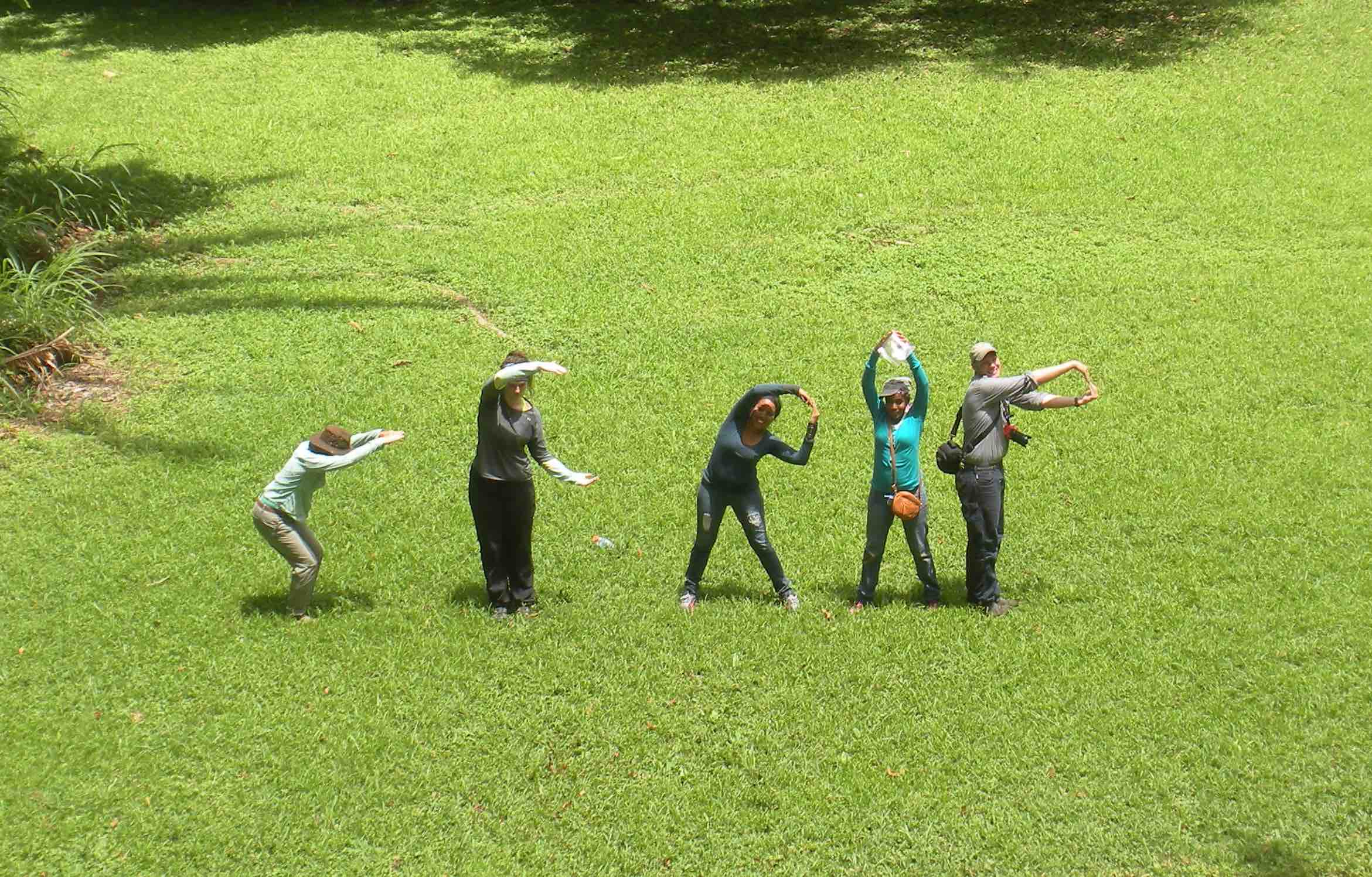
Instead of posting a picture of Mayflower, we will post a picture of SCRAP crew members trying to spell out SCRAP at Mayflower!
After we finished exploring and learning about Mayflower, we drove up to Dangriga. Shawn had the best day ever because we went to Marie Sharp’s factory and took the tour. Plus we got to have all the samples we wanted. He was in pepper heaven!
Friday the weather gods were smiling on us and we worked a full day in the orchard. Nothing was mowed but we trudged through tall grass to surface collect on mounds that SCRAP had located in 2014. We made great progress and checked quite a few mounds off the map.
We were exhausted after a long day in the hot field but we knew we had an exciting evening ahead of us! As mentioned (and blogged), earlier in the week we made clay source briquettes in order to determine which clay sources may have been used by the ancient Maya in the area. So Friday night we got permission from the hotel owner to fire them, which obviously meant we had to have a bonfire and it only makes sense that bonfires need s’mores! SCRAP s’mores nights are possibly the best nights. We had a great time using biscuits/cookies instead of graham crackers, Cadbury chocolate bars instead of Hershey, and chocolate flavored marshmallows.
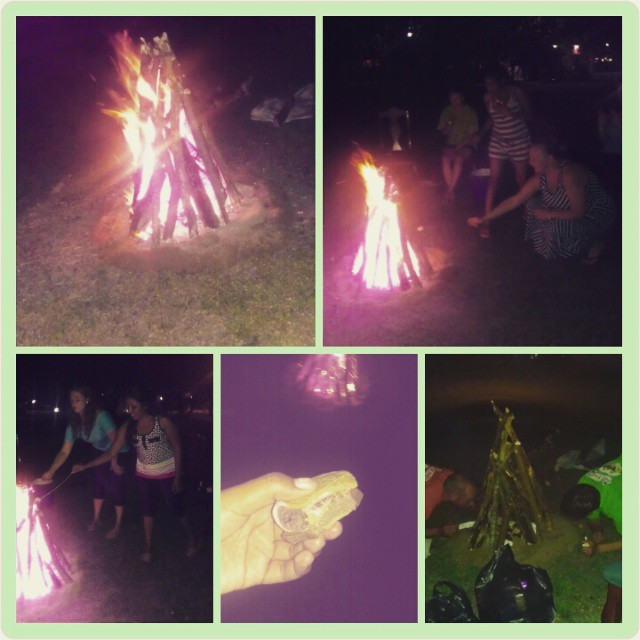
Firing clay sample briquettes and eating S’mores!
Saturday we did a half-day, focusing on cleaning and analyzing the artifacts we found this week, and Tawny analyzed the granite with pXRF. After our half day we had arranged to take a tour of a nearby Maya chocolate factory. It was awesome! We got to see cacao trees, learn what kind of environment they thrive in, how they are harvested and then treated in order to go from white, slimy beans to delicious chocolate nibs. But to be fair, the slimy beans were super delicious to begin with.
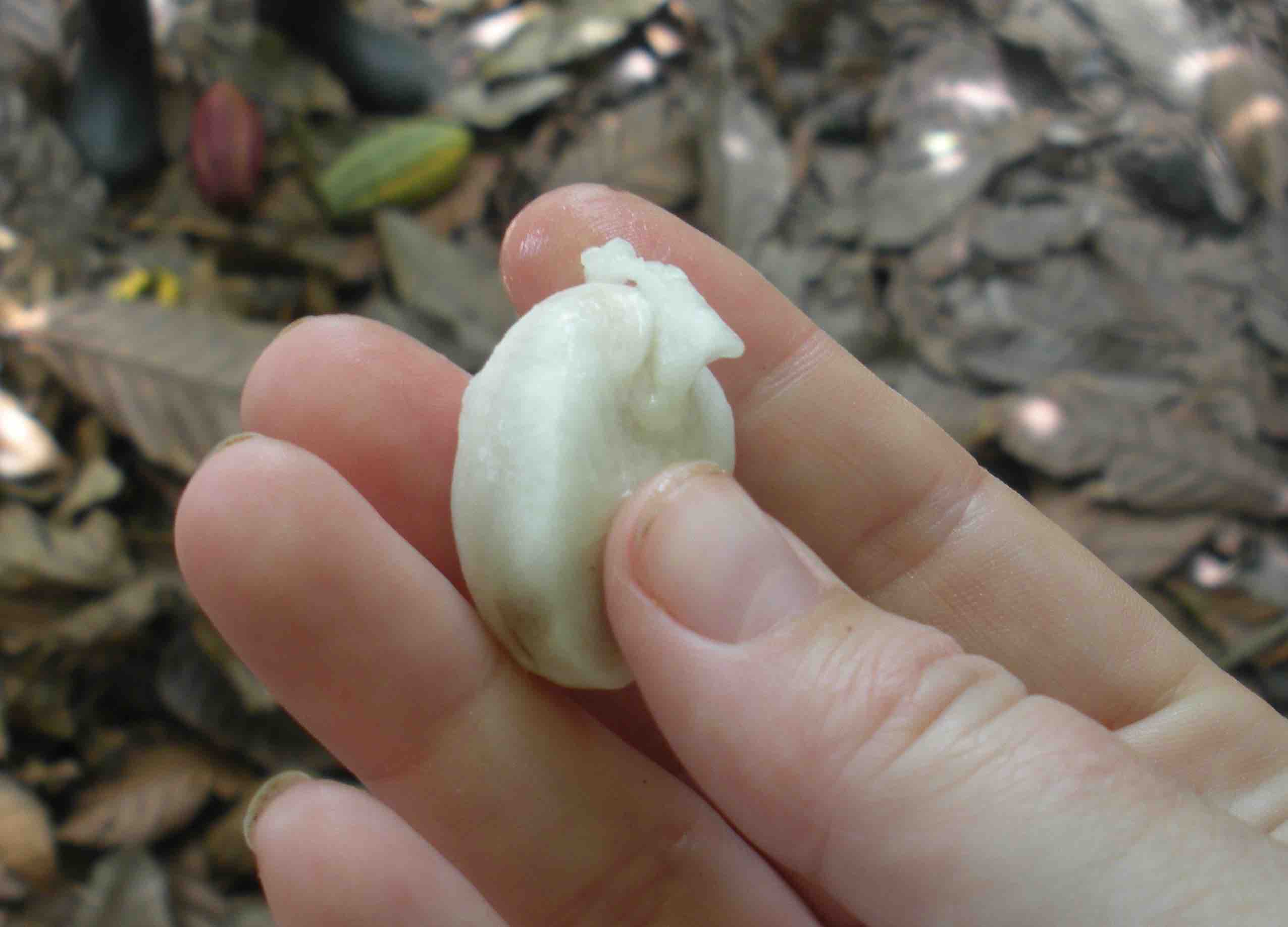
Fresh cacao bean
We also got to grind our own chocolate with a basalt mano and metate! We ground up our beans into dark chocolate and then enjoyed the spoils of our work after they had been in the freezer for a bit. The chocolate was delicious but we all agreed that it was best left to the professionals; grinding that much chocolate is hard work!
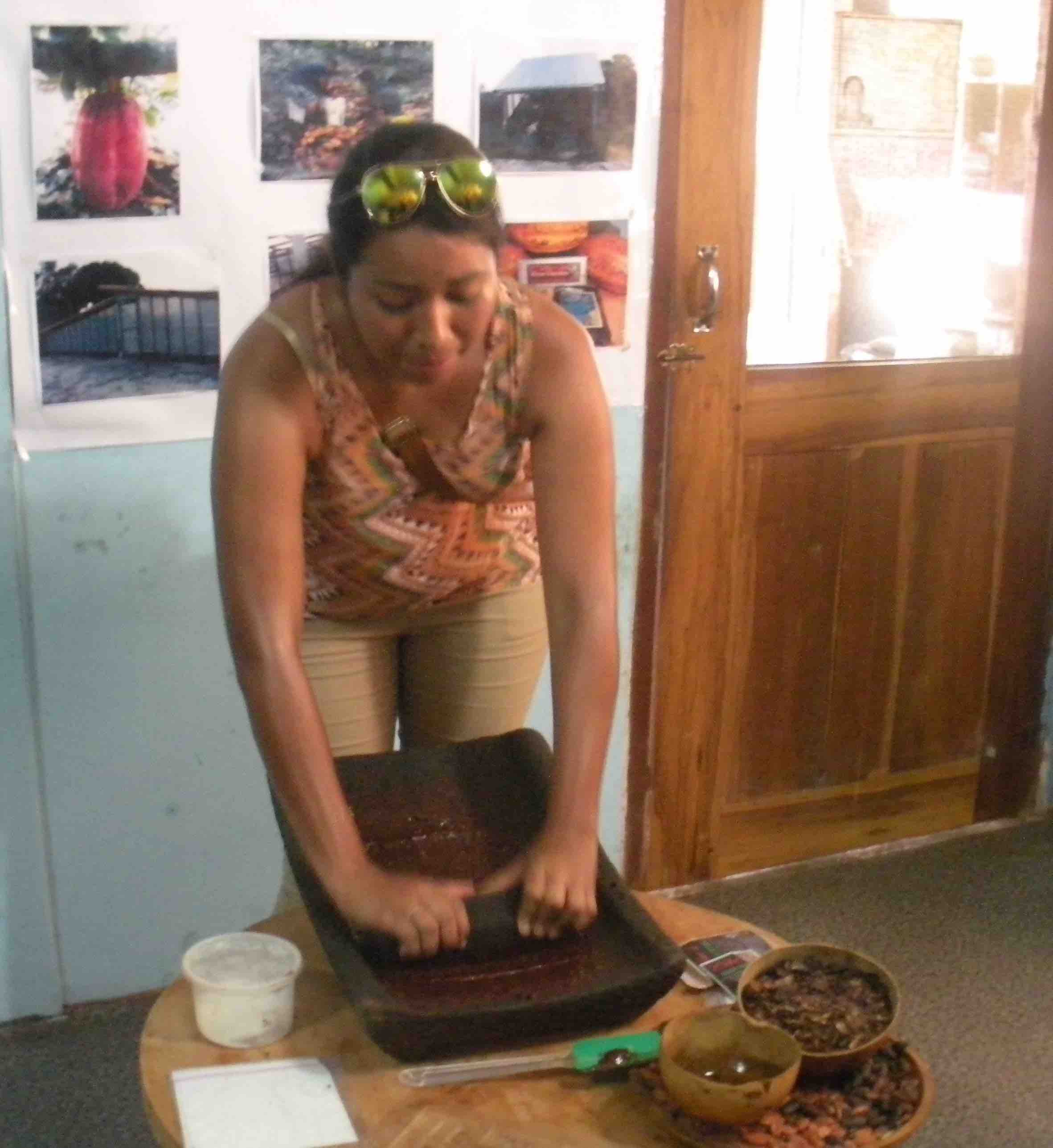
Jesucita trying her hand at cacao grinding
Now that we have enjoyed our weekend making chocolate and relaxing on the beach in nearby Placencia, we are rested and ready for another week of hard work!
Cheers from Belize!
Lisa & Tawny
 The Stann Creek Regional Archaeology Project