Maya Archaeology is an exciting field of research, with many ancient places (sites) and belongings (artifacts) uncovered each year. Particular areas of interest for archaeologists and local communities include “where” and “when” the Ancient/Ancestral Mayas settled on the landscape, “what” they built when they arrived and “how” they lived everyday–e.g., acquired raw materials, crafted their various belongings, and then distributed, used, and disposed of these items–as well as more complex questions of identity or “who” they were and “why” they settled in these locations.
The Ancestral Mayas–whose descendants are the Maya Peoples of the Maya World today (over 8 million people)–had sophisticated methods and systems of resource extraction, manipulation, and trade going back to Formative times (ca. 1800 B.C.- A.D. 250) and continuing well into recent times. In concert with these activities, villages, towns, and cities sprung up in advantageous places on the landscape, parallel to increasing degrees of urban complexity.
One little understood area of urbanization/settlement aggregation and commodity procurement/trade lies along the eastern face of the Maya Mountains in Belize to the coast. This is a material culture sub-region within the Eastern Maya Lowlands, and is referred to as East-Central Belize (roughly modern Stann Creek District). The Stann Creek Regional Archaeology Project (SCRAP) aims to rectify this knowledge gap, and current investigations are focused on the sites of Alabama (a.k.a. Chacben Kax) and Pearce. These names are historic designations for the archaeological sites; the ancient Mayan names remain unknown.
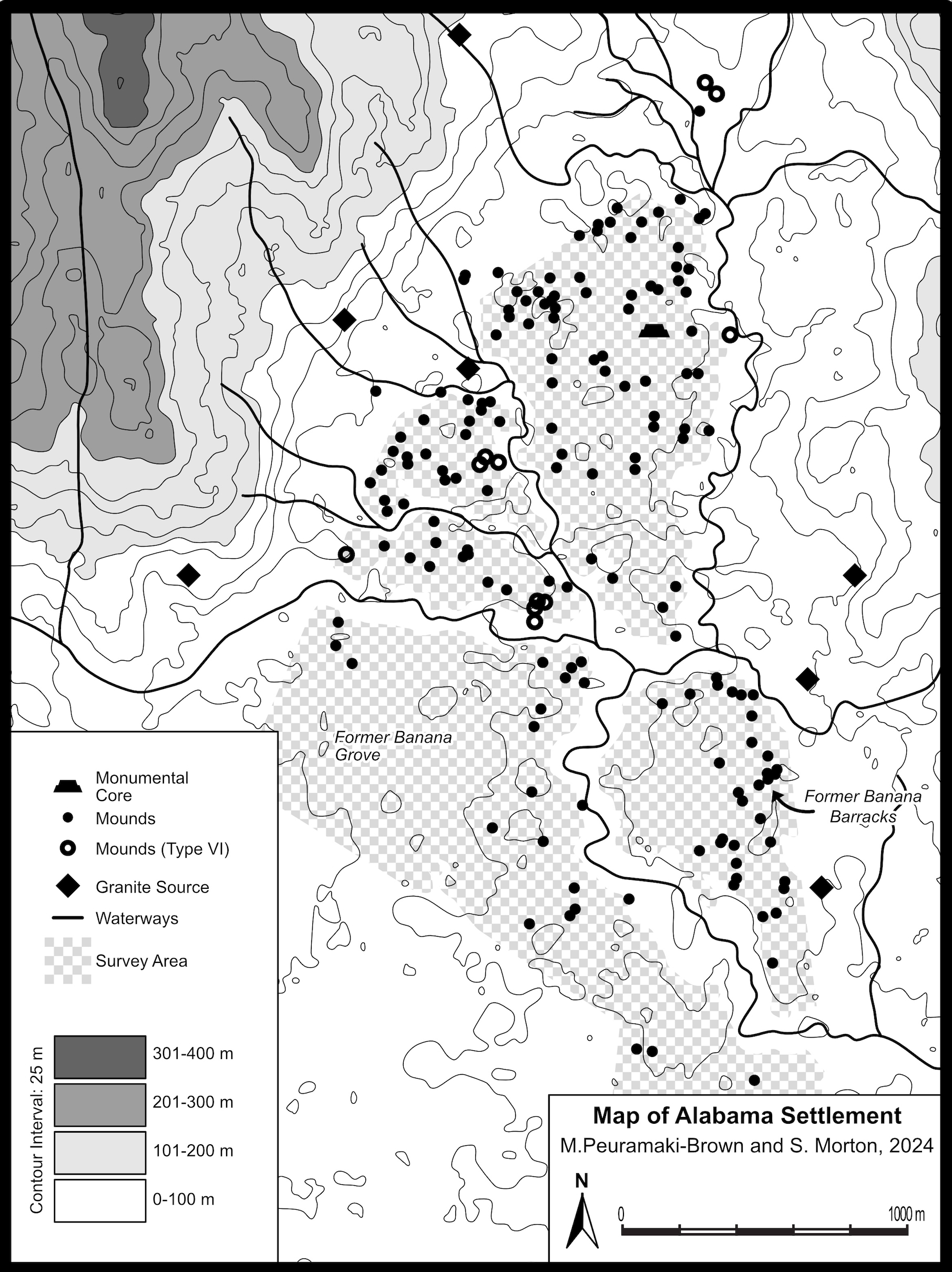
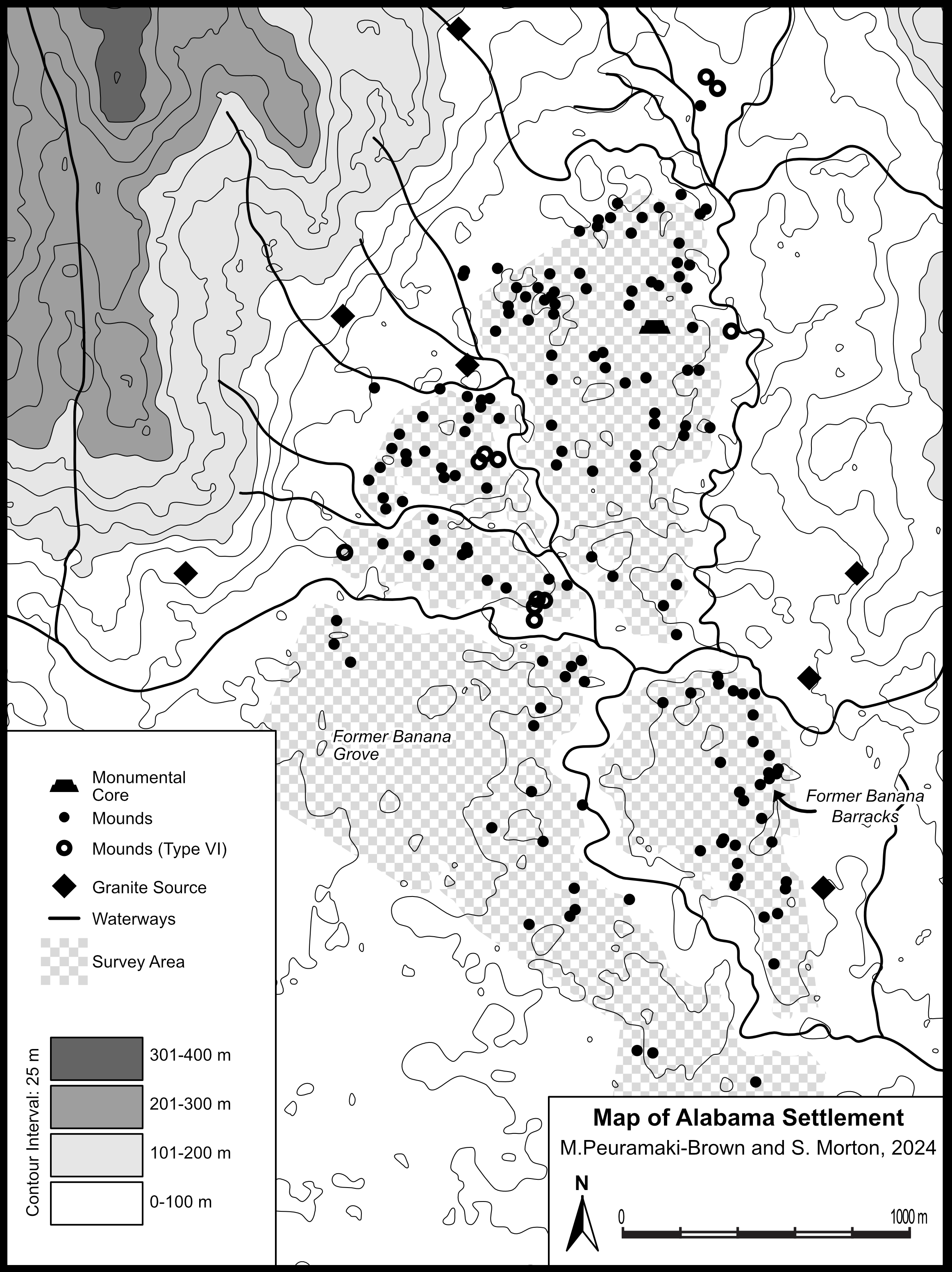
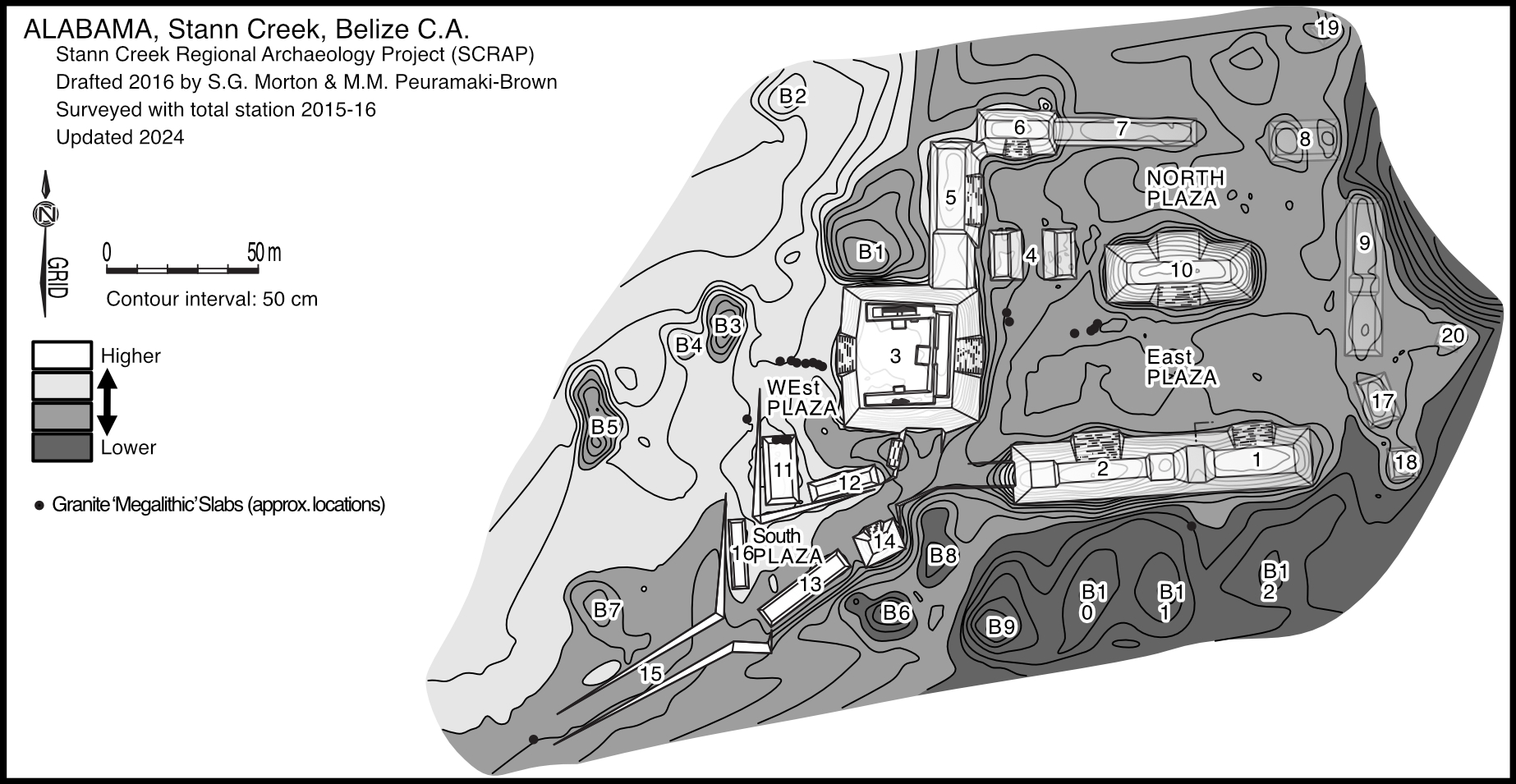
The Alabama monumental core (epicentre) consists of 20 major structures (the tallest, Str. 3, measuring 7.5 m), 4 plazas, and sacbe. The epicentre covers 2.48 hectares, not including neighbouring borrow pits or Strs. 19 and 20, which is slightly larger than the monumental core of Nim Li Punit in Southern Belize. Fourteen plain, granite monuments have been previously noted at the site. Alabama is classified as a small to medium major ceremonial centre (see map below). Based on SCRAP settlement survey in 2014 and 2015, the population estimates for Alabama are calculated to roughly 1000 people at the height of occupation in the late facet Late Classic to Terminal Classic (ca. AD 700-900).
Our investigations of the site of Pearce, roughly 10 km north of Alabama, were initiated with a preliminary reconnaissance in 2016 and a LiDAR survey in 2019/2022 (results forthcoming).
 The Stann Creek Regional Archaeology Project