
As we’re gearing up for a big year on SCRAP (more on this in an upcoming post this autumn), we wanted to reinvigorate our blog after a few years of relative neglect. So, over the coming months, we’ll be posting several items on various topics in advance of our posts “from the field” next spring/summer. Consider signing up with your email address to follow along (see right-hand side of our webpage).
This blog post is the result of numerous conversations we’ve had on SCRAP over the years about the public’s frequent confusion between archaeology and palaeontology. It was written by SCRAP team member Mr. Alson Ovando of Dangriga Town in Stann Creek District, who recently completed his MSc in Geosciences with a concentration in Palaeontology at East Tennessee State University. Enjoy!
——————-
In Belize, both archaeology and palaeontology share many similarities and differences. This blog post hopes to communicate some of the aspects that differ and overlap between the two sciences from a Belizean context.
What is Archaeology and Palaeontology?
Archaeology is the study of past people and societies through artifacts and other human records. Artifacts are products created or manipulated by humans and are found in a geologic context. Some examples of artifacts include tools, architecture, art, and other human-made objects. Palaeontology is the study of past life on Earth through fossils. Fossils are the natural remains or traces of living things found in a geologic context. Some examples of fossils include bones, droppings, leaf imprints, animal footprints/trackways, seeds, pollen, shells, and many other traces of life. One major difference between Palaeontology and archaeology lies in the types of scientific questions each field seeks to answer. Palaeontologists study animals, plants, and other living organisms over time (so, not just dinosaurs), while archaeologists focus on questions about humans and their ways of life. In some instances, archaeology and palaeontology can intersect near the boundary of the fossil record and archaeological record.
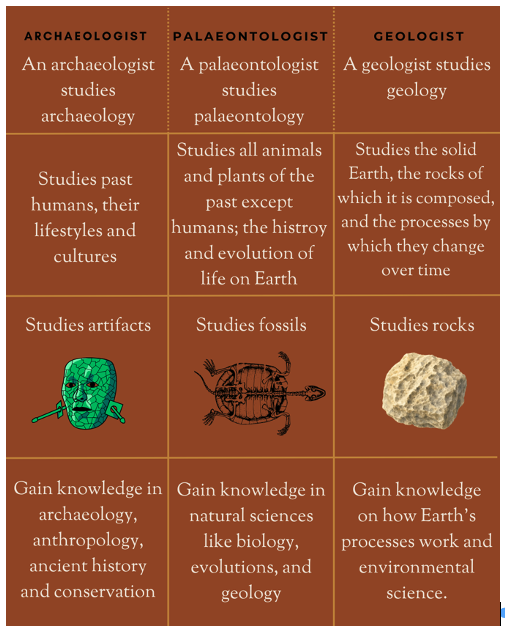
Image modified from “Dinosaur Fossil Park and Museum, Rahioli-Balasinor” Facebook Page
Where do people find fossils or artifacts?
In Belize, fossils can be found in caves, cenotes, rivers, and larger rock units around the country. Archeological sites and artifacts can be found almost everywhere in Belize—essentially, anywhere humans are or have been. In many cases, fossils and artifacts can be found in close proximity to each other. It is common for the fossil record and archaeological record in Belize to be found in separate geologic contexts.
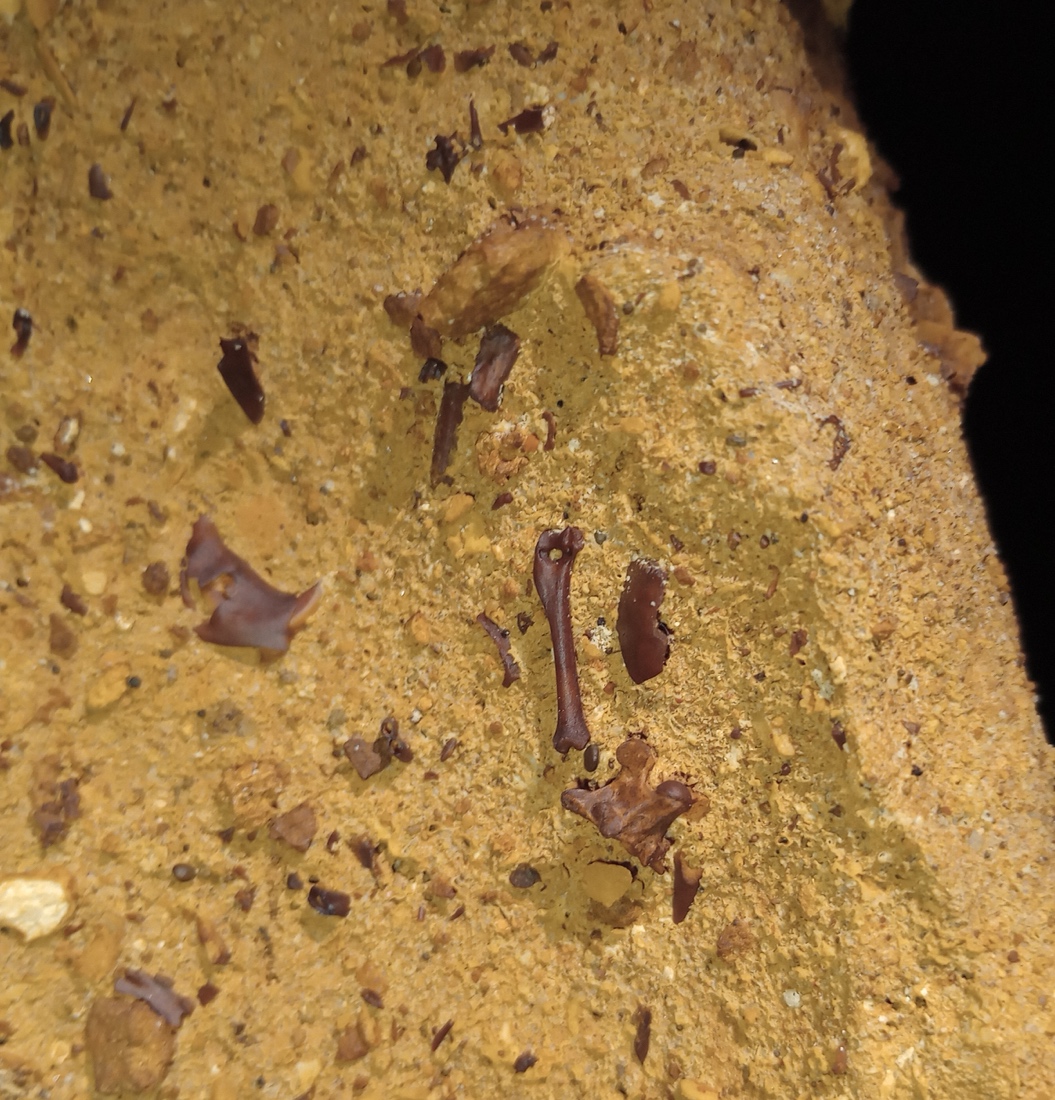
Vertebrate microfossils from Belize found in bone breccia along cave walls. Photo by A. Ovando.
Excavation and Stratigraphy:
All the factors or conditions associated with a fossil or artifact when we first find them in the ground can be referred to as geologic context. Geologic context can help us learn how old a fossil or artifact is, how it got there, and other valuable historical information. Therefore, excavations at fossil and archaeological sites are conducted through a standardized, meticulous process to capture as much geologic information as possible. During excavations, both archaeologists and palaeontologists try to dig within a predetermined area called a unit (see this previous SCRAP post about unit setup). These units are set up in areas of Belize known (or hoped) to contain fossils or artifacts. In a typical unit, the objective is to record each artifact or fossil as you dig downward incrementally. The reason for doing this is not only to find artifacts or fossils but also to understand the geologic context of each specimen recovered. Understanding the geologic context allows scientists to use stratigraphy to estimate the age of an artifact or fossil. In Belize, stratigraphy is an understudied area of geology that helps us to understand the age of sediments, rocks, fossils, artifacts, and larger geologic units across the country.
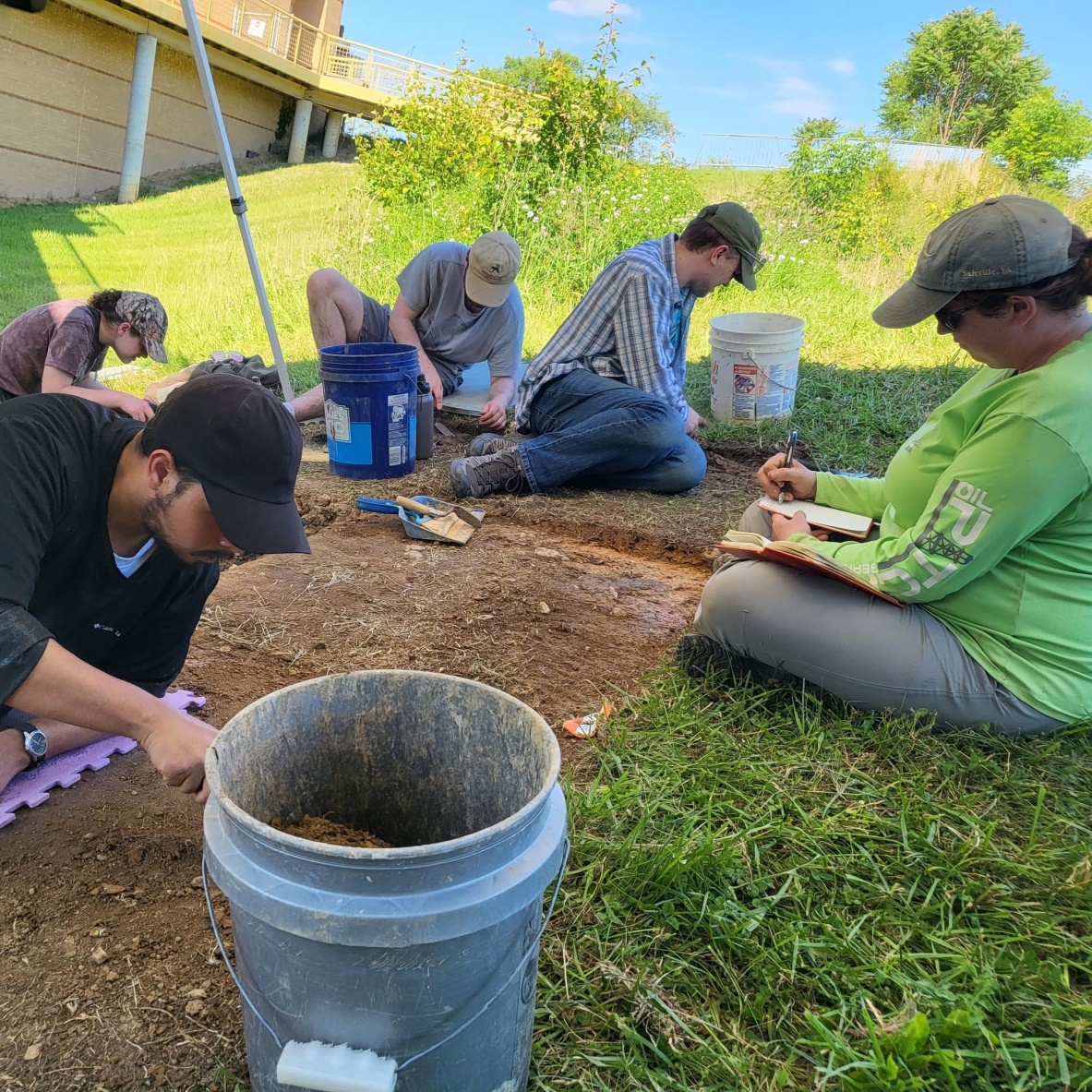
Gray Fossil Site & Museum 2024 Field Season. Picture from the Gray Fossil Site & Museum Facebook page: May 22, 2024
When excavating a unit, you can expect changes in sediment colour and texture as you go deeper. Along the sides of the unit, you might be fortunate enough to have well-defined lines that are separated horizontally. These lines are known as stratigraphic lines, or “strata,” and can serve as natural time markers to help tell the story of each specimen found during the excavation. In many cases, though not always, the stratigraphic lines become older as the excavation proceeds downward. There are many ways to determine the stratigraphic ages in a unit. Two very common practices include absolute and relative age dating. In Belize, we can use a very reliable form of absolute age dating called radiocarbon dating. Radiocarbon dating techniques only work on organic materials such as bone or charcoal that are preserved well within the last 50,000 years (check out this recent SCRAP article about radiocarbon dating at the Alabama Townsite). Radio carbon dating can be very expensive and is usually conducted by labs outside Belize. Therefore, radiocarbon dating is reserved for materials with the best preservation. Archaeologists in Belize use radiocarbon dating, particularly for Ancestral Maya materials and sites of their predecessors. In addition, paleontologists can use radiocarbon dating to determine the direct age of fossils that preserve organic materials.
Relative age dating is another method used to determine the stratigraphic ages of a unit by using the known ages of fossils or artifacts found in each stratigraphic layer. When enough research has been done at a particular fossil or archaeological site, some fossils or artifacts can be used as reliable indicators of age range. For example, certain styles of Maya ceramic pots were more commonly made during some periods over others. Therefore, the style of Maya ceramic pots can be used to suggest the age range of an archaeological site or stratum. Similarly, palaeontologists use the presence or absence of specific taxa/species at a fossil site to estimate an age range for the site. The challenge with using relative age dating in Belize is that we have to rely on comparable well-researched artifacts and fossils, which we don’t always have. Even though similar artifacts or fossils found in Belize may also be found outside Belize, that doesn’t always mean they are the same age. Thus, relative age dating should be used in conjunction with other geologic dating methods.
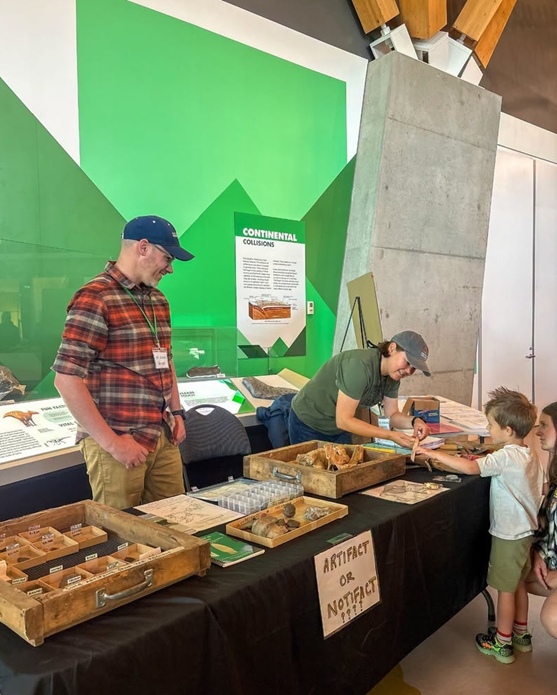
SCRAP directors hosting an archaeology information booth at a palaeontology museum in Canada. They were invited by museum staff because the public often confuses archaeologists with palaeontologists. Both are extremely cool and fashionable in their field gear, so it is unsurprising.
The Quaternary: Pleistocene and Holocene
An important factor distinguishing the archaeological record from the fossil record in Belize is time. Much of the human record in Central America is limited to the Holocene (Cohen et al. 2023). The Holocene spans between 11,700 years ago and the present day. The geologic time period that came before the Holocene is called the Pleistocene, and it spans approximately 2.6 million to 11,700 years ago. During the Pleistocene, multiple prehistoric species lived across the Americas. Some of those species went extinct or became extirpated during the end of the Pleistocene. Therefore, it is assumed that the fossils of extinct animals found in Belize so far are older than the Holocene. Currently, archaeologists are still trying to understand when humans first arrived in Belize (e.g., Prufer et al. 2021). Simultaneously, palaeontologists are trying to understand when certain megafauna such as short-faced bears, wild horses, gomphotheres, and giant ground sloths went extinct across the country. It is possible that humans lived alongside (now extinct) megafauna in Belize. One day, by studying the stratigraphy of certain locations across Belize, we might be able to identify localities that contain both fossils of extinct megafauna and artifacts in the same age strata.
References and Further Reading:
Cohen, K.M., Finney, S.C., Gibbard, P.L. & Fan, J.-X. (2013; updated) The ICS International Chronostratigraphic Chart. Episodes 36(3): 199-204.
Ovando, A. 2026. On the Paleontology of Belize. MSc thesis, Department of Geosciences, East Tennessee State University, Johnson City. Available at https://dc.etsu.edu/cgi/viewcontent.cgi?article=6197&context=etd
Prufer K.M, Robinson M, Kennett D.J. 2021. Terminal Pleistocene through Middle Holocene Occupations in Southeastern Mesoamerica: Linking Ecology and Culture in the Context of Neotropical Foragers and Early Farmers. Ancient Mesoamerica. 32(3):439-460.

