Week 4 (Session 1) & BAAS

13466059_525497153609_1732084198256997115_n

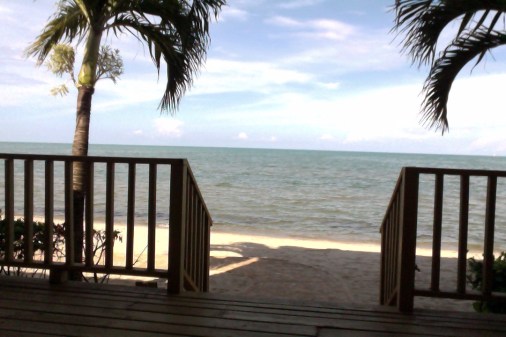
Placencia

On Monday, June 20th, the start of Week 4, the crew returned to the field after a lovely weekend off. Cristina, Megan and Kelsey spent the weekend relaxing and drinking Mango Coladas on the beach in Placencia.  Meanwhile Meaghan and Shawn were stuck in Independence working on their conference papers for the upcoming BAAS [*insert jealous cries of frustration here*].

IMG_0731

Defining ceramic wares

On Monday evening, Jill Jordan joined our crew in Independence! Meaghan brought Jill out to the site on Tuesday morning to familiarize her with the area.  Following this, the two of them returned to the hotel to conduct analyses on the ceramics recovered from the site thus far.  Jill was kind enough to provide some insight into the antiquity and nature of some of our possible local and “exotic” ceramics, helping to further understand the occupation span of the settlement, and to begin addressing some of the preliminary results of our characterization studies (you can learn more about these at the SAA meetings in Vancouver in 2017).

stock-vector-simple-woodcut-image-of-a-person-trapped-at-the-bottom-of-a-hole-64396987

A depiction of Megan in her pit (well, not really her, but that’s what it looked like. Thanks to shutterstock.com for this one)

The goal for the crew in Week 4 were to try and finish the units that were started in the area of ALA-047. Monday and Tuesday was spent in the field continuing to dig at our respective units. Megan spent Monday digging her deeeeep unit on Mound C in an attempt to reach sterile matrix and natural geological layers.  She needed to reach up to 40cm without finding any artifacts so that she could close her unit prior to her departure back to Canada at the end of the week [*If she didn’t, we would force her to stay 🙂 ]. Monday proved to be successful and she dug down 20cm with no artifacts to be found.  Tuesday morning continued this same way and it was looking like Megan was going to complete her goal of finishing her unit ahead of schedule.  This was until on Tuesday afternoon while they were digging, the extremely lucky (or unlucky, depending on how you look at it), Mr.Idelfonso came across one lone obsidian blade in the pit.  This meant that the soil was not sterile and Megan had to begin the process of excavation to 40cm of sterile soil all over again.

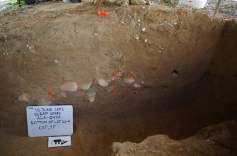
Cristina and Virginia spent Monday excavating the layers below the daub feature that they had previously removed from the back side of Mound B. They then worked on excavating the entirety of the second daub feature in their unit until that was entirely removed. Following this, they opened a profile window along the southern wall of their unit that was 50cm by 1.25cm. They opened this window in an attempt to reach sterile soil so that they could close their unit. On Tuesday they continued digging the window but were unsuccessful in reaching sterile as they were still recovering numerous artifacts.
I spent Monday and Tuesday with Mr.Sylvestro continuing to dig down into the unit on Mound A in search of our ever-illusive architecture. The search was thus far futile and still by the end of Tuesday, to our dismay, no architecture (platform face) had been discovered.
13582229_10154670670509316_1062155102_o

Crew watching the power of an army ant migration (right through the unit)

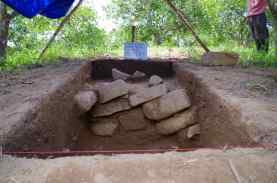
Shawn and Mr.Juan continued the excavation of their intriguing “pile of rocks” [*a.k.a. Mound D*] on Monday.  They discovered that it appears as though the rocks form an alignment, although the exact interpretations of what they could represent are still being debated. On Tuesday, Shawn and Mr.Juan were forced out of their unit temporarily as it was overtaken by army ants as they cleared across the landscape taking out all living things in their path. It was a spectacle to see for those of us who have never witnessed the power of all of these small creatures moving in unison [*This migration made perfect sense on Wednesday when we were hit by a huge rain. You can read more about Army Ants here: http://www.insects.org/entophiles/hymenoptera/army-ants.html *].

13570105_10154670670419316_135702436_o

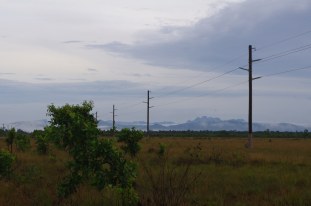
Rain clouds over the Maya Mountains

Wednesday was an interesting day for the crew as we were awoken in the morning to the roar of thunder nearby.  The crew drove to Maya Mopan and discovered heavy rainfall.  As a result, Meaghan decided that it was best not to attempt to dig through mud all day and the digging was postponed.  Instead, we returned to Independence to conduct lab work for the day.  Cristina, Megan and I spent the morning conducting basic analysis on the artifacts that had been recovered earlier in the week.  The afternoon was spent completing the cataloging and analysis of all of the obsidian recovered from our excavations to-date.

13579702_10154670670769316_65419739_o

Scanning

Meaghan and Shawn spent the day using the 3D scanner to record some of the artifacts recovered at the site. Some of these scans are available online for those of you who are interested in seeing them. (here is one: https://sketchfab.com/models/5370085ca4c64aa082d5b19c11649eda).  All of our scans will ultimately become part of the Athabasca University Virtual Archaeology Lab. This will be an Open Education Resource (OER), hopefully up and running by early 2017.

On Thursday we returned to the site and Cristina discovered the sad fact that the rain from the day before had flooded her unit (despite tarps and sand bags). She then spent Thursday morning bailing out the water. The subsequent mud that was left made digging in her unit impossible; therefore, she spent the day mapping the plan view (top plan) of her unit as well as the profile map of the entire mound.
For Megan, Thursday morning was spent digging through another 30cm of sterile sediments. After recovering no artifacts, it was decided in the afternoon to close the unit as she had come across natural sand and gravel layers. The rest of the day was spent straightened the walls, taking closing photos, and stringing up profile lines. Friday was then spent completing a top plan, a profile of the unit north wall, and a profile of the platform face.  Following this, and the recording of much additional information, the unit was then closed and Megan was allowed to return to Canada (sad face).
Mr. Sylvestro and I spent all day Thursday and Friday morning on a mission to find the mythological wall within the mound.  We continued to dig in a mad attempt but still made no progress.  In a sad personal defeat, we finally decided to call it quits on this unit temporarily (until Session 2).  Friday afternoon was spent creating a wall profile of the few blocks that we had exposed, which we then tied into a profile of the entire mound that we mapped.
Shawn, Mr.Juan, and Mr. Idelfonso continued to dig in their unit to attempt to reach sterile levels so that they could also close their unit. They are close (we think). On Friday, Cristina was attempting to also locate sterile soil in her unit so that it could be closed as well.  To her dismay (but also, excitement), about 2 hours before we were completing the fieldwork for Session 1, she discovered a new feature in her unit. This means that she will continue in this unit next session to uncover the feature. The entire crew then spent the rest of Friday ensuring all of the units were properly protected from the elements for the coming week.
13567132_10155016743074966_5418422520386168739_n

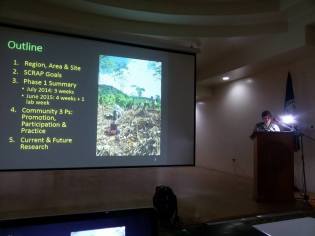
Meaghan presenting about SCRAP at the Belize Archaeology & Anthropology Symposium

Meaghan, Shawn, Cristina, Megan and I left Independence on Saturday morning to come to San Ignacio.  We spent the night in town and said goodbye to Megan on Sunday as she flew back to Canada.  The remaining 4 of us spent the week in San Ignacio at the Belize Archaeology and Anthropology Symposium (BAAS) hosted by the National Institute of Archaeology. We learned much about the other research happening in the area, and Meaghan presented a preliminary overview of the first two years of research by SCRAP.

After a wonderful week off, the crew is itching to get back into the field! We will keep you posted on what kind of awesome activities we get up to in Session 2!
Ciao,
Kelsey

Week 3: Digging, Expanding Units, and Digging some More

IMGP0238

Breakfast tamales from Ms. Juana’s kitchen

Last week (Week 3) was a down and dirty type of week, filled with breakfast tamales, moving large quantities of dirt (Editor’s Note: soil and sediment… matrix… check out TMZ for “dirt”), expanding of units, and some super basic survey work (Shawn was doing it, after all).

Mound A:

IMGP0313

Platform face at Mound A. Where is it??

Kelsey and Mr. Juan started the week by expanding their unit a meter north in a futile attempt to find any semblance of architecture. After two full days of excavating this new expansion the decision was made to once again increase her unit another full meter north. But alas, poor Kelsey had no such luck in finding her imaginary building; she spent the remaining two days of the week leapfrogging between her two, 1 m expansions in an attempt to bring them down to the depth of her original unit. Then tragedy struck! With the frustration of Mr. Juan growing daily with the lack of artifacts found, he was moved to a more fruitful unit (aka Mound D), leaving Kelsey feeling abandoned and sorrowful. But a gracious Sylvestro bit the bullet and joined Kelsey for the last day of the week, and they have a new strategy for this week.


Mound B:

IMGP6071

Feature fun at Mound B

The most magnificent of mounds, was continued by me and Virginia. We began with a 50 cm by 1 m expansion of our unit in an attempt to chase a rather large feature that continued into our northern wall. Our entire week revolved around this one feature. We spent the first few days removing the topsoil of our expansion until the very top of our feature appeared. It was then that we began the painstaking process of carefully exposing and mapping the boundaries of our monstrosity of a feature (for more details, watch for the 2016 report in early 2017). For two full days this was the only goal in sight. Various carbon samples, soil samples, and bags full of matrix allotted for floatation later, our goal was met. All we had left to do was to, very lovingly, excavate it (internal screaming). So, Friday morning, with Meaghan’s help, we divided our feature in quarters and set to work removing all artifacts and soil (once again for floatation). This is where I have to admit that my beast of a digging partner Virginia shined; she carefully dug out our feature faster than I could complete the write up. With all paperwork finally completed and our feature completely removed, we ended the day thanking the archaeology gods that we had not messed it up.


IMGP0331

Floating feature matrix.


Mound C:

Megan and Mr. Idelfonso spent the week with the sole goal of finding where their platform face ended, with the idea that this will also be where the theoretical living surface would appear. After several days of moving massive quantities of soil, with no end in sight, it became more and more apparent to Megan that this face did in fact reach all the way to China. In a drastic change of pace, Megan and Mr. Idelfonso were allowed a one-lot break on Thursday to dig on the top of their structure in order to find out what was being used as fill. Spoiler alert!!! It was more dirt [Editors Note: see note above].  By the end of our half-day on Friday, a miracle occurred and the bottom of their platform face was finally found. Hallelujah!

IMGP0249

Upper courses of Mound C platform face, made of granite blocks.

Epicentre/Mound D:

Shawn, with Sylvestro in tow, spent most of the week mapping the site core, which was finally completed by the end of the workday on Wednesday.  He then joined the rest of the crew in our blistering orange orchard, to continue the unit he had opened the week before. Although much of this unit remains to be excavated, it is already becoming one of the more unusual units. This is due to the large quantities of stone that have been found throughout the unit. Perhaps this is where all of Kelsey’s missing architecture has gone!?! Unfortunately, we were forced to wait in anticipation for the next week (final week of Session 1) to see what would appear.

IMGP0217

Mound D excavations


After work/Friday afternoon:

IMGP0360

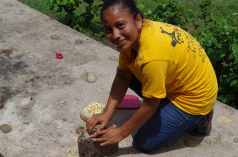
Experimental grinding

IMGP0296

Use-wear study

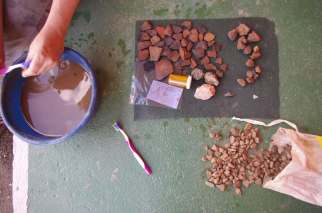
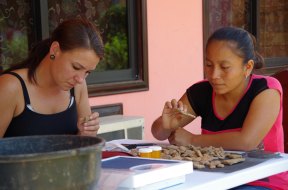
In order to keep up with the quantities of artifacts that are being uncovered daily we have gotten into the habit of having ‘washing parties’ [Editor’s Note: she means “partay”] every afternoon after the field. What this entails, is everyone sitting around washing artifacts with some pretty sick tunes playing [Editor’s Note: courtesy of Shawn… Everyone else’s music is below standard.  Don’t get me started on the “trifecta of awesome”] and perhaps a cold beer in hand. Not only have we been doing that, but we have also started to process all the soil that was allotted for flotation. We also started our experimental grinding and metate use-wear study (more on that later). In order to complete all the lab work (which includes washing, flotation, cataloguing, and basic analysis) we only dug for a half-day on Friday. Further, due to it being Megan’s last weekend in Belize, it was a mad dash [Editor’s Note: but responsible] to finish up all our work before heading out on the water taxi to Placencia (aka. a little slice of paradise). With only a few minutes to spare, we made it!

Até logo! [Editor’s Note: YOLO!]

Cristina

Week 2: Digging (Rain), Mapping, Exploring

view of mountains

Looking from the coast toward the Maya Mountains

Last week (Week 2) at SCRAP was an eclectic mix of activities. Some excavations gained momentum, some just began, and others decided to take a long lunch.  There were several opportunities for learning new field mapping techniques, evening artefact washing parties, artefact cataloguing and basic analysis, and another field trip to a nearby site! Our excavation goals for the week were to try to uncover and expose any architecture of the housemounds (buried building platforms) we are investigating, so we might gain a better of understanding of their layout/design and begin to piece together their occupation histories by recovering debris from both on and off platform areas.


Excavating

Testing at a residential platform

The crew awoke bright-eyed on Monday morning ready to once again be bestowed with the shimmering glow and sweet scent that 35ºC heat and +65% humidity leaves on your skin. Shawn and I headed out to the epicentre in the morning so I could learn more about mapping with a total station.  The rest of the crew headed out to our settlement site excavations in the orchard, after Mr. Juan, Mr. Idelfonso, and Mr. Sylvestro graciously set up shelters over units. Cristina, Virginia, and Mr. Idelfonso worked in one unit to expose more of the granite facing blocks they uncovered the previous week, while Kelsey, Mr. Sylvestro, and Mr. Juan worked on another excavation unit in search of the up-‘til-then elusive face.  I returned from the epicentre after lunch and joined Kelsey, while Mr. Sylvestro joined Shawn to continue mapping.


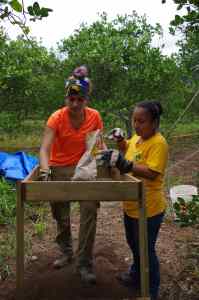
Screening

Screening

Tuesday was a full excavation day for everyone on site; Cristina, Virginia, and Mr. Idelfonso continued in their unit with the goal of trying to further expose any architecture and fall. Kelsey, Megan, Mr. Sylvestro, and Mr. Juan worked on their mound in attempt to find any evidence of the building, which appeared to be covered in much overburden, but instead found a lot of sandy loam and a very large root that bore a strong resemblance to a shrunken head. Shawn and Mr. Jason continued to work on mapping the epicentre, and Meaghan remained on site with the rest of the crew guiding and helping between units.


Survey

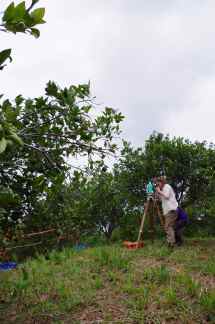
Mapping mounds and shooting in excavation units with a total station

Those of us in Independence awoke in the middle of Tuesday night to a fantastic thunderstorm, complete with torrential rains (a result of Tropical Storm/Cyclone Colin further north). When we arrived on site both units had been impacted by the storm, despite our shelters; one had a small pool of water that had accumulated while the other had a large hole in the northwest corner from the collapse of a massive ant nest (which has apparently caused significant disturbance at our mound, shifting entire architectural blocks from their original positions). We removed the water from the one unit and sandbagged the tops of its walls, and gave the other unit a stern talking to and left it to think about what it had done. We also made sure to allow our units to dry out for the day, and to “bathtub” each with a second tarp at the end of each day.

IMGP0104

Getting ready to tape-and-compass map our new mound

But all was not lost for the day, and what was a loss in one area transformed into a great opportunity for learning in others. Meaghan decided that we would open our next unit on another mound at the group, and so Kelsey, Cristina, Virginia, and I measured out and set up the new excavation area (see our upcoming post on unit set up for an idea of how that went). Later, Cristina worked with Shawn on using the total station to start mapping the site while Meaghan taught Kelsey, Virginia, and I how to tape-and-compass map a new mound discovered in the bush, within spitting distance of our settlement site. After lunch, Cristina continued working with Shawn and Mr. Sylvestro; Meaghan and Virginia attempted work in one unit that had dried; and Kelsey, Mr. Juan, Mr. Idelfonso, and I began work at the new unit.


wash

Evening artifact washing

Rain in Independence on Wednesday night had us all worried for what condition our units would be in on Thursday but luckily it had been a relatively dry night at Alabama and our tarp-and-sandbag system worked well.  Excavations continued on two of the mounds, but since our one badly behaved unit (the poor ant-eaten one) was still throwing a temper tantrum, Kelsey fine-tuned her total station skills with Shawn and Mr. Sylvestro.  Excavations continued into Friday with Kelsey finally able to resume working at her mound.


Artifact_Cataloguing

Cataloguing and basic analysis

Saturday morning was spent learning how to properly catalogue artifacts and conduct basic analysis on materials that had been uncovered and washed over the first two weeks of excavation. Virginia came with us back to Independence on Friday evening and helped us with our morning work. That afternoon we headed out to Lubaantun in Toledo District and stopped in at Punta Gorda afterward for a lee drink.


Lubaantun

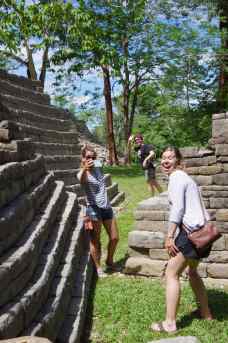
Learning (and having fun) at Lubaantun, Toledo District

And so ended another knowledge-filled and productive week at SCRAP. Stay tuned for more exciting adventures!

IMG_0565

Fun in Punta Gorda


Cheers,

Megan Williams


Folktales from the field

IMGP0068

 Virginia regaling fellow crew members with folktales from her village

There are many stories in Belize. The popular folklore of the country is a unique blending of many different influences, from Kriol, to Spanish Mestizo, German Mennonite, Garifuna, and of course various Maya peoples. Perhaps the most ubiquitous of characters/creatures spoken about around campfire, table, and excavation unit are Tata Duende and Ixtabai. We were treated this week to a version told by our friends and colleagues from Maya Mopan, Virginia and Sylvestro. When it comes to tales of the supernatural, most of these stories give us the willies, so please excuse our paraphrasing… we may have passed out once or twice.


Tata Duende – Tales of Tata Duende are told everywhere in Belize.  Though his feet are attached backwards, he sure gets around!  By all accounts, he is an ugly little man wearing a large-brimmed hat, and has no thumbs.  He doesn’t seem to let this get in the way of his romantic aspirations, and routinely lures attractive women away from their homes with his sweet guitar licks.  However, Tata Duende lives deep in the Belizean jungle, and that is normally where he is encountered.  He is said to greet children who walk the jungle trails, and politely ask to see their hands.  Watch out! Lest you oblige and Tata Duende rips (or cuts) your thumbs clean off!  Parents also warn their children that if they skip class, Tata Duende will lure them into the jungle, never to be seen again.


In general, however, Tata Duende is a benign spirit; a trickster and shape-shifter that can disguise himself as animals or other people and is often invoked to explain strange events around the home and farm.  Sylvestro tells how his friend used to keep horses around his house.  Sometimes, at night, their manes would get hopelessly tangled and would have to be cut off.  Tired of this, they moved the horses to another location.  The next morning, his friend’s sister’s hair was knotted and tangled into a horrible mess!  As untangling her hair could be seen as a portent of death, they left things as they were and brought the horses back.  The next morning, the sister’s hair was no longer tangled, but the horses were once again due for a shave.

Xtabai (Ixtabai) – Look, but don’t touch!  Wait… it’s probably best not to look either.  Xtabai is a bit of a black widow; she uses her long raven hair and sweet voice to enrapture men and draw them to a grisly end.  According to Virginia, her favourite prey is jealous men, particularly if they have been harsh or inconsiderate toward their wives or girlfriends.


Cadejo – Another one of our favourite stories (or nightmares) is that of the Cadejo.  Most often described as a big dog with a length of chain tied around its neck and sometimes with burning red eyes and goat hooves, the Cadejo may be either benevolent or malevolent depending on which aspect you are chance to encounter.  While the White Cadejo will escort the pleasantly sopped (tipsy) home and protect her/him from would-be robbers, the Black Cadejo will lead the drunk to their demise.

If you happen to be stumbling home and hear the loud sound of a chain right behind you… don’t worry, the Cadejo is a long way away.  On the other hand, if you hear the faint jingle of a chain far off and smell a strong odor of goats you may be in the presence of the Cadejo.  Don’t turn around!  To see the Cadejo is to go mad.  Beware.

There are plenty of other spirits and creatures in Belize.  Check out the internet.  Talk to a friend over a rum.  Keep your eyes on the jungle and watch out for your friends!


Stay safe!

Shawn and Meaghan

Week 1: Field Kits, Site Tours, Unit Set Up, and Excavations!

IMGP0044

Tour of epicentre

Last week, our first official week of SCRAP 2016, was jam-packed with learning and activity as the crew got their introductions to the site and learned about unit setup  and excavation techniques. On Monday (and Tuesday), we were all introduced to the site by touring the epicenter and around the settlement within the orchard areas. Visiting the epicenter gave us a general understanding of the architecture present at Alabama, and we discussed the various structures and their proposed uses.

After touring the site, we returned to our lovely air-conditioned hotel (it was very hot in the orchard) to sharpen our trowels and prepare our field kits for the upcoming excavation (see previous blog post, https://scraparchaeology.com/2016/06/01/what-exactly-is-in-an-archaeologists-field-kit/ ).

IMGP0029

Prepping field kits

IMGP0018

Sharpening trowels


On Tuesday, our entire group (archaeologists, students, and field assistants) returned to the site and discussed our “plan of attack” for the season. Following this discussion, we returned to the orchard to clear the mounds of vegetation where we would be setting up our first units. Any exposed artifacts on the surface were collected after the mounds were cleared, and exposed granite blocks were flagged. This allowed a better understanding of the spatial extent and orientation of the mounds, which are presumed to be platforms that supported perishable domestic structures.

IMGP0055

Unit set up

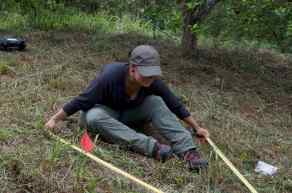
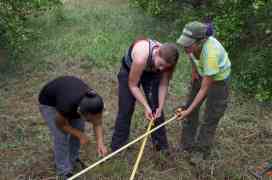
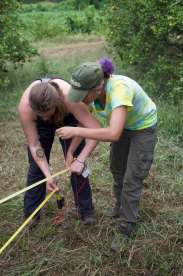
Based on this information, we then set up excavation units (suboperations) on two of the mounds. This was done using systematic methods (which we will introduce in an upcoming blog), and a lot of patience and a lot of re-measuring.  Excavations of the units then commenced, with Cristina and Virginia working on the backside of one mound and Megan and Kelsey along the front slope of another. Shawn worked with the rest of the crew at the epicenter in order to complete mapping using the total station. On Wednesday and Thursday, excavation of the two subops continued in the orchard and granite blocks and evidence of the perishable superstructures (daub) began to appear.  Shawn and the remainder of the crew continued their work in the epicenter.
LearningToDig

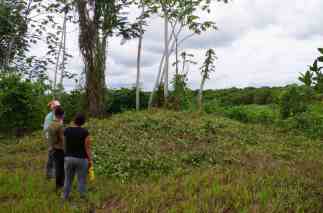
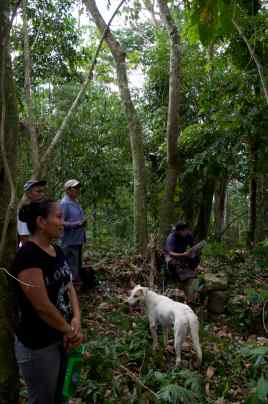
Excavations in the settlement zone

The fifth day in the field was a rainy one! Megan accompanied Shawn, Sylvestro, Jason, Idelfonso, and Juan to continue clearing and mapping the epicenter, and to learn about how a total station is used to create topographic maps. Due to the continuous rain (and lack of shelter for our screening area… which has been rectified in Week 2), our day of fieldwork was cut short. As an alternative, Meaghan brought our crew to the site of Nim Li Punit in the northern end of Toledo District.  This site was chosen in order to familiarize the crew with additional examples of architectural features that may be encountered during excavations at Alabama this season.  Overall, the week was a productive one full of learning and new experiences and we are looking forward to what Week 2 has to offer!

13388781_10209235818395049_1449969268_o

Visiting Nim Li Punit

Until our next post!

Kelsey

What exactly is in an archaeologist’s field kit?

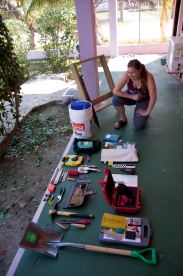
This Monday was spent assembling all the materials we require for the field. In this blog post, we introduce you to “The Field Kit.”

IMGP0031

Kelsey admiring an amazing field kit.

One of the most important parts of archaeological field work is making sure that you have the proper equipment to complete your project in a precise and consistent manner.  Archaeological field work is often conducted in relatively remote areas, and ensuring that we have the necessary tools prior to entering the work site enables us to be well-prepared for a variety of tasks and situations.  In this blog we are going to give everyone a brief summary of some of the common items that you would normally find in any archaeologist’s kit.


Kit1

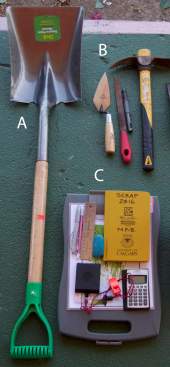
(A) Shovel; (B) trowel, files, pick; (c) clipboard, maps, notebook, forms, pencils, rulers, erasers, protractor, calculator, orienteering compass

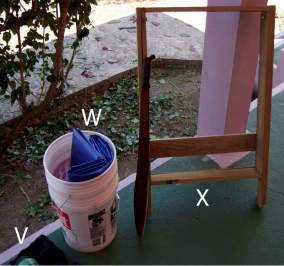
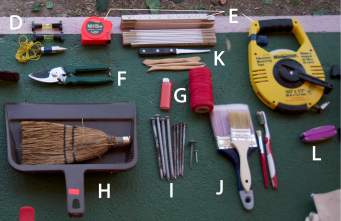
The first and most recognized tool is a trowel (B).  Trowels come in various shapes and sizes, but for most people a drop-forged, pointing trowel is ideal (Marshalltown is a popular brand).  Trowels are used to remove sediment (matrix) in order to uncover artifacts and features. It is important to maintain sharp edges on your trowel to assist in soil removal; one way to accomplish this is to always have a bastard file or triangular file in your kit. Sometimes bigger tools are needed to remove larger amounts or more compact soils; therefore, it is always good to carry a shovel (A) and geology pick or mattock (B) to site with you.  Conversely, smaller brushes and dust pans (H, J), wooden sculpting tools (K), or carefully wielded dental tools, are often needed to delicately remove soil from artifacts or move smaller amounts of material from your work area. Buckets (W) are used to hold and carry the removed soils/sediments to shaker screens (X) where it is poured out and inspected for smaller artifacts, floral and faunal material, or other items that may have been missed at the trowel’s edge.  Archaeologists typically use ¼” mesh for screens, though tighter meshes may be used to ensure collection of micro debitage or other smaller materials.
Kit2

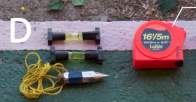
(D) line levels and plumb bob; (E) metric rulers and tapes; (F) clippers; (G) nylon twine and lighter; (H) whisk broom and dust pan; (I) corner nails and datum nails; (J) assorted small brushes; (K) small picking tools; (L) utility knife

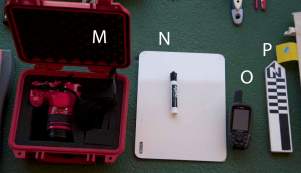
In archaeology, provenience and context are everything. Some of the most basic tools for determining location include metric rulers and tape measures (E) and an orienteering compass (C). These tools are used to determine the horizontal and vertical dimensions of the unit and associated levels/lots that you are excavating, as well as the location of artifacts and features in 3D space.  Sometimes, we get to break out the big guns, using tech such as dumpy levels, transits, total stations, or GPS (O).  Nylon string (G) is an important tool to bring to the field because you are using it with many other items, such as line levels (D) for maintaining accurate depth levels, a plumb bob for measuring horizontal provenience relative to level baselines, and nails (I) for marking the boundaries of your excavation area.  In some instances, your site will be overgrown with roots or trees and sharp tools such as root cutters (F) and machetes (X) are used to clear this away from the work area. A multi-tool or small knife (L) is always a good thing to carry as well.  We’ve all met people whose walls are so straight that we suspect they dig with lightsabers, but this remains unconfirmed.

Kit3

(M) camera; (N) photoboard; (O) GPS unit; (P) scale arrow

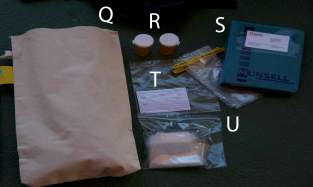
Another very important (arguably the most important) aspect of any archaeological fieldwork is accurate and thorough documentation.  Every archaeologist should have an adequate supply of pens, pencils and erasers for filling out project forms, their personal field notebook (C), and drawing maps and profiles. A clipboard with a hard writing surface is also useful for carrying all your paperwork, as well as functioning as a portable drawing surface.  Another tool used for documentation is a Munsell colour chart (S) and soil texture chart, for providing standardized matrix descriptions. A camera (M), photoboard (N), and scale arrow (P) are also used to document the progress of excavation.  Sealable plastic or cloth bags of various sizes (Q, U), small containers (R), artifact cards and tags (T), and tin foil pockets are all important for holding artifacts and ecofacts to be removed from the field.

Kit4

(Q) Cloth artifact bags; (R) containers for small, delicate artifacts; (S) Munsell colour chart; (T) artifact tags; (U) assorted plastic bags

Safety equipment is imperative on archaeological sites.  A personal as well as a project first aid kit should be readily available.  If you are working in the sun a hat is a good idea, as well as plenty of water and sunscreen in your field pack (V).  Bug repellent is a must, especially if you are working in an area in which the insects carry serious illnesses, like malaria! Wearing the proper clothing for your environment is important and some archaeologists feel more comfortable using knee pads and gloves in the field. When archaeological sites are part of more formal work environments, hard hats, steel toed boots, and safety vests and goggles are also a common sight.

Kit5

(V) field pack, waterbottle; (W) bucket and tarp; (X) machete and shaker screen

We think that this pretty much covers the basics of an archaeological field kit. However, depending on where and when your field work is taking place you might have to complement your kit with more specific items.

Until our next post!

The SCRAP 2016 Team

(Cristina, Kelsey, Meaghan, Megan, Shawn, Virginia)

Another Year, Another “Greetings from Belize”!

Greetings from Belize!

The time has come once again for a summer of field research in Belize. Shawn and I arrived last weekend and we have been busy making final preparations for our third season of SCRAP, which will last two months this year. Yesterday, I picked up our permit from the Institute of Archaeology, so we are now officially a go! Our team arrives on Saturday, we head to Stann Creek on Sunday, and we are in the field bright and early on Monday.

IMG_0500

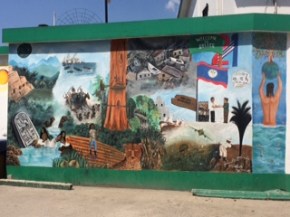
Mural about Belizean history. San Ignacio, Cayo District.

This season we will be completing our topographic map of the epicentre; conducting test excavations at residential mounds in the settlement; investigating a borrow pit and possible reservoir; and continuing with our various material studies (granite, clay/pottery, obsidian, etc.).

The plan is to once again provide a posting each week to this blog, detailing what we are up to—field methods, discoveries, various side adventures—which will be brought to you by different team members throughout the season.

We hope you enjoy our posts and we wish everyone a wonderful summer full of beautiful weather and great adventure!

Cheers,

Meaghan

The 2015 Final Report and Upcoming 2016 Field Season

Hi Everyone!

I wanted to let you all know that the final report of our 2015 season is posted under the “Publications” tab.

I just submitted the report to the Belize Institute of Archaeology this morning, and had a meeting with the Director of Archaeology to submit our application for the 2016 permit. It is shaping up to be a great season, during which we will complete the topographic mapping of the epicentre and begin test excavations at numerous mounds within the settlement, as well as in the borrow pits around the epicentre. We will also have the chance to formally visit and assess some of the sites in the neighbouring Cockscomb Basin for future archaeological consideration by SCRAP.

Cheers from Stann Creek, Belize!

Meaghan

Photo on 2016-03-02 at 1.45 PM

Greetings from Hopkins, Stann Creek District, Belize